
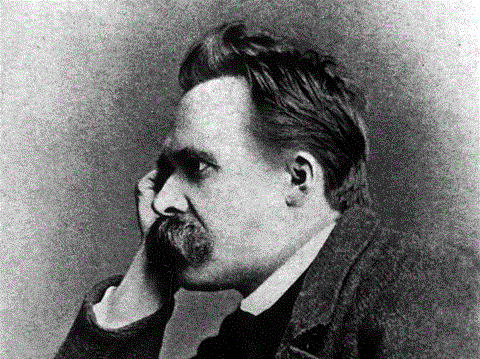
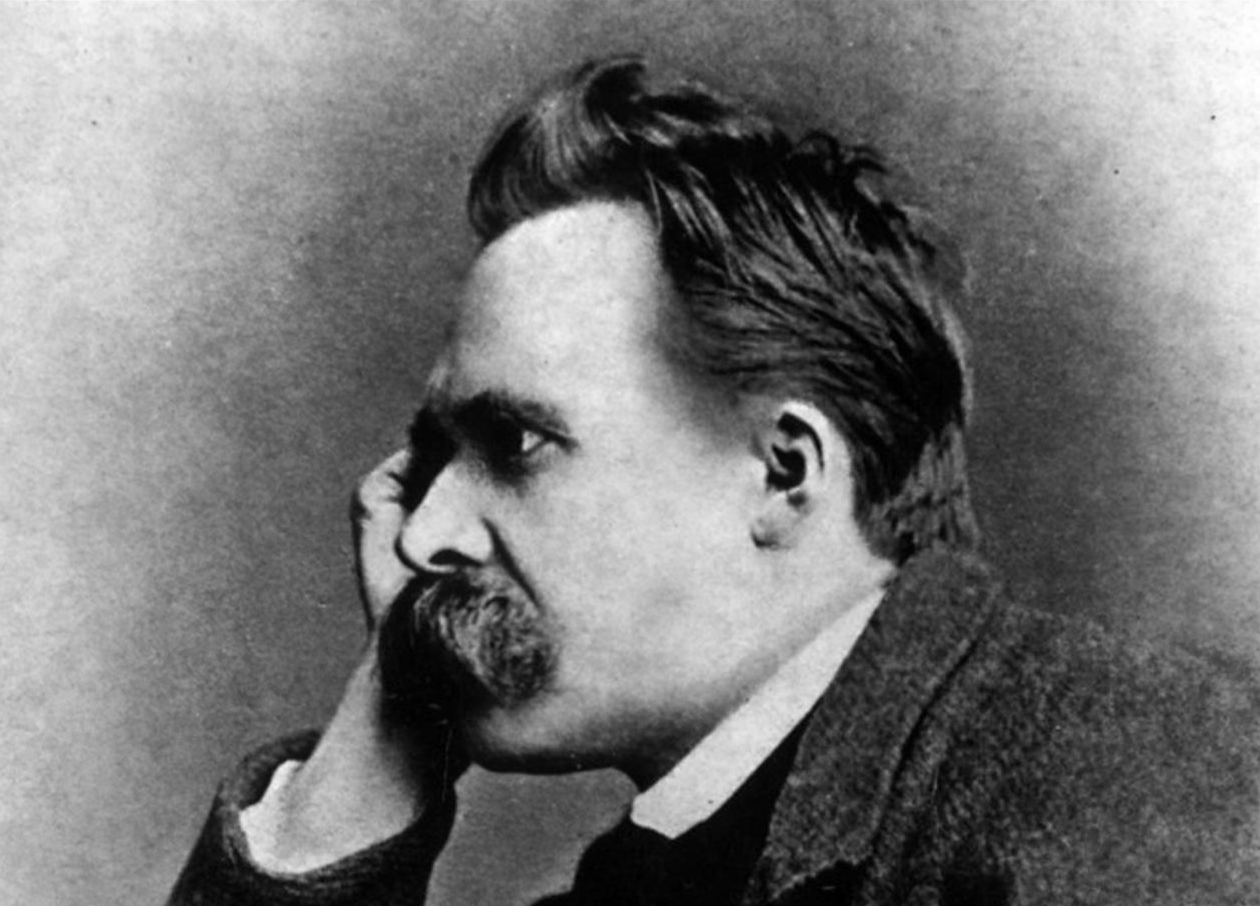
A philosopher perhaps more widely known for his prodigious mustache than for the varieties of his thought, Friedrich Nietzsche often seems to be misread more than read. Even someone like Michel Foucault could gloss over a crucial fact about Nietzsche’s body of work: Foucault remarked in an unpublished interview that Nietzsche’s “wonderful ideas” were “used by the Nazi Party.” But that use, he neglected to mention, came about through a scheme hatched by Nietzsche’s sister, after his mental collapse and death, to edit, change, and otherwise manipulate the thinker’s work in a way The Telegraph deemed “criminal.” Foucault may not have known the full context, but Nietzsche had about as much sympathy for fascism as he did for Christianity—both reasons for his break with composer Richard Wagner.
What Nietzsche loved most was music. Even in the wake of this scandal, with Nietzsche fully rehabilitated at the scholarly level at least, the philosopher is generally read piecemeal, used to prop up some ideology or critical theory or another, a tendency his anti-systematic, aphoristic work inspires.
A more holistic approach yields two important general observations: Nietzsche found the mundane work of politics and nationalist conquest, with its tribalism and moral pretensions, thoroughly distasteful. Instead, he considered the creative work of artists, writers, and musicians, as well as scientists, of paramount importance.
https://www.youtube.com/watch?v=playlist
Nietzsche almost entered medicine and was himself an artist: “before he engaged himself fully as a philosopher, he had already created a substantial output as poet and composer,” writes Albany Records. In an 1887 letter written three years before his death, Nietzsche claimed, “There has never been a philosopher who has been in essence a musician to such an extent as I am,” though he also admitted he “might be a thoroughly unsuccessful musician.” In any case, he hoped that at least some of his compositions would become known and heard as complementary to his philosophical project.
Now serious readers of Nietzsche, or those simply curious about his musicianship, can hear some of his compositions online. The music ranges from sprightly to pensive, romantic to mournful, and some of it seems to come right out of the Protestant hymnals he grew up with as the son of a Lutheran minister. Nietzsche composed music throughout his life—a complete chronology spans the years 1854, when he was only ten, to 1887. See The Nietzsche Channel for a thorough list of published Nietzsche recordings and sheet music.
Note: An earlier version of this post appeared on our site in 2015.
Related Content:
An Ancient Philosophical Song Reconstructed and Played for the First Time in 1,000 Years
Listen to Music Playlists to Help You Study Like Nietzsche, Socrates, Kant & Other Great Thinkers
Nietzsche’s 10 Rules for Writing with Style
An Animated Introduction to Friedrich Nietzsche’s Life & Thought
Josh Jones is a writer and musician based in Durham, NC.