
The Chinese filmmaker Wang Bing’s ‘Til Madness Do Us Part, a documentary about a mental institution in Yunnan, runs three hours and 48 minutes. Beauty Lives in Freedom, on the life of imprisoned artist Gao Ertai, is five and a half hours long; Dead Souls, on the survivors of a hard-labor camp in the Gobi Desert, eight hours and fifteen minutes. Even if you know nothing else of his work, you may get the impression that Wang isn’t the most shamelessly commercial of filmmakers. The extreme duration of some of his movies surely make them a hard sell, as do his grim choices of subject matter. But if you want to understand the transformation of modern China, you could hardly find a richer body of cinematic work.
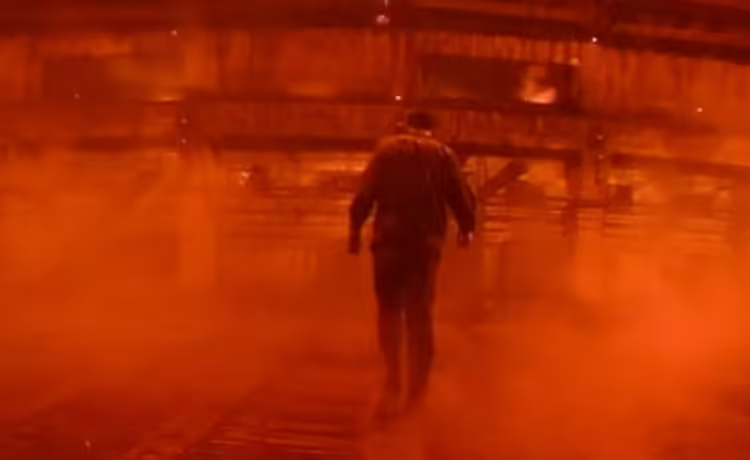
In the video essay above, YouTuber Ken Dai extols the virtues of Wang’s first film: Tie Xi Qu: West of the Tracks, whose more than nine hours of footage depict the last years of the titular industrial district of Shenyang. Wang draws them from the more than 300 hours he shot in the years between 1999 and 2001, by which time a shift in economic policy had made redundant what had once been not just a concentration of state-owned enterprises, but “a monument to a vision of the future.”
Tie Xi employed countless many in the foundries and factories that made possible the dramatic early decades of China’s economic rise, but for its workers and their families alike, it had also become a stage on which generations of life played out.
Wang bears witness to that stage’s dismantlement. In the film’s first part, Dai says, “we watch the workers show up, day after day, to a system that has already decided they’re no longer necessary.” The second turns to “the families, and particularly the teenagers”; the third “follows a freight railway that once connected all of it, and two men, a son and a father, who live and scavenge for scrap metals.” They and the many other remaining Tie Xi denizens who pass before Wang’s camera speak for themselves. At no point does the film incorporate narration, interviews, or even non-diegetic music. (There is, however, an impromptu performance by a nude guitar-playing man in a barracks.) In its refusal to use its people as metaphorical figures or political props, Tie Xi Qu stands as an example of “direct cinema” at its most direct — except, perhaps, for Wang’s later clothing-factory documentary, the aptly titled 15 Hours.
Related Content:
285 Free Documentaries Online
50 Must-See Documentaries, Selected by 10 Influential Documentary Filmmakers
Watch the Film That Invented Cinema: Workers Leaving the Lumière Factory in Lyon (1895)
Based in Seoul, Colin Marshall writes and broadcasts on cities, language, and culture. He’s the author of the newsletter Books on Cities as well as the books 한국 요약 금지 (No Summarizing Korea) and Korean Newtro. Follow him on the social network formerly known as Twitter at @colinmarshall.