
Guest Blog by Daria Gasparini, Architectural Historian with Robinson and Associates
In 2023, the Cedar Haven Civic Association on the Patuxent River, Inc., received a Historic Preservation Non-Capital Grant from the Maryland Historical Trust to document two African American summer resorts founded in the 1920s along the Patuxent River in Prince George’s County: Eagle Harbor and Cedar Haven. The grant also provided the opportunity to update Maryland Inventory of Historic Properties documentation for another African American landmark in Aquasco – the historic Woodville School.
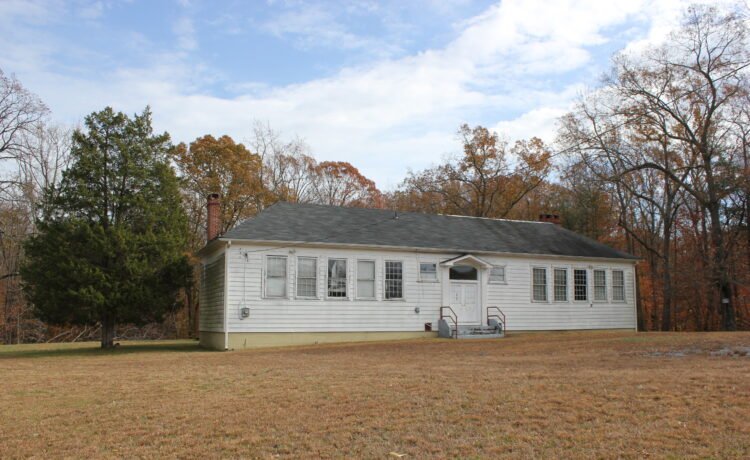
The Woodville School (PG: 87B-34) stands in a clearing along Aquasco Road in southern Prince George’s County. From 1934 until its closure in 1956, the school provided public elementary education for African American children living in the village of Aquasco. After the school closed, the local commandery of the Knights of St. John, a Catholic fraternal organization, purchased the building for use as a social hall, ensuring its ongoing preservation.

History of the Woodville School
Towns and villages were slow to develop in the far southeastern section of Prince George’s County, where plantation owners tended to conduct business directly from private wharfs, eliminating the need for inland trade centers. By the early nineteenth century, however, a village named Woodville had formed around the junction of the road from Horsehead (now Aquasco Road) and the road to the wharf at Trueman’s Point (now Eagle Harbor Road). Woodville was located within the Aquasco Election District, which had one of the largest concentrations of free African Americans in the state in 1860.

Faced with a woefully inadequate and discriminatory state education system, African American communities relied heavily on mutual aid societies and church groups to fill the gaps in public education. Early financing and support for Black schools also came from Freedmen’s Bureau, the federal agency established by Congress in 1865 to help emancipated African Americans adjust to the new conditions after the Civil War. By October 1868, the Bureau had helped establish eight schools in Prince George’s County, including one in the village of Woodville. This school was likely located on the grounds of the John Wesley Methodist Episcopal Church (PG: 87B-33) at 22919 Christ Church Road.
The Prince George’s County Board of School Commissioners announced in August 1872 that the county would be establishing schools for Black children in each election district as required by state law. The following month, a large delegation of the county’s African American residents attended the board’s meeting to represent the interests of its Black schools. Among the attendees were seven trustees of the “Woodville Colored School,” including Richard Douglas, James Gray, Walter Thomas, three founding trustees of John Wesley M.E. Church.
Five years would pass before the school board took the necessary steps “for building colored schoolhouses nos. one and two in Aquasco District.” School No. 1 was located in Woodville and School No. 2 in Poplar Hill (PG:87A-12). The school in Woodville was erected in 1877 on a 1-acre parcel of land along Aquasco Road. The front-gable, frame building measured 20 by 30 feet and was constructed for $300.

By the early 1920s, the student body at the Woodville Colored School had increased sufficiently to warrant the retention of two teachers, and attendance numbers continued to rise. Despite great strides by the state in providing funding for education, Black schools continued to lag far behind their white counterparts and rural schools behind those in urban and suburban areas. In October 1930, three trustees from the Woodville Colored School petitioned the school board for a new, larger building. Receiving no immediate response, the Woodville delegation continued to press the issue, returning to the board four months later. At the time, the Woodville Colored School had ninety-eight pupils enrolled in a schoolhouse originally built to accommodate thirty-three. In March 1931, the county introduced a bill to the Maryland legislature for a $275,000 bond issue for erecting and repairing school buildings, and Woodville was one of seven projects slated to receive funding. The allocation was $6,000 for a new three-room building.
The bonds were not immediately issued, and by 1932 the effects of the Great Depression had hit the state with full impact. Maryland’s governor, Albert C. Ritchie, who had delayed applying for federal relief, changed course in 1933, creating an opportunity for the county to reissue the bonds, which were awarded to the United States government in January 1934 through the Federal Emergency Administration of Public Works, later renamed the Public Works Administration (PWA).
On March 7, 1934, the school board purchased a 2.65-acre lot in Woodville that was located across the road and about 100 yards north of the prior school property. In September of that year, the proposed new Woodville School was withdrawn from the list of county schools to be erected with PWA funds. Instead, it would be constructed with labor furnished by the Federal Emergency Relief Administration and materials purchased by the Board of Education. Although the Washington, D.C., architectural firm of Upman & Adams was at the time designing the county’s PWA-funded schools, it is not known for certain whether the firm designed the Woodville School since it was funded through a different source.

The new school, completed in 1934, was a one-story, frame building with a hipped roof and a raised concrete foundation. It featured three classrooms, each with five tall windows, hardwood floors, and a coal stove for heat. There were two cloakrooms, a large central hall, and a separate room, smaller than the main classrooms, in the back of the building that may have functioned as an industrial room for teaching practical skills or as a principal’s office/classroom.
With the landmark 1954 Supreme Court decision in Brown v. Board of Education, state-sanctioned segregation of public schools was ruled unconstitutional. In Prince George’s County, however, the process of eliminating racial discrimination in schools was a gradual one. The county adopted a “freedom of choice” plan for school desegregation, which meant that, in theory, families had a choice where to send their children. Black families, however, faced administrative roadblocks, harassment, and discrimination. For the 1955-56 school term, despite the fact that the official racial designation of the county’s schools had been eliminated, 96 of the county’s 104 schools remained either all white or all Black, including the Woodville School.
In April 1956, the Prince George’s County school board presented a $6 million-dollar school construction program to the County Commissioners. Among the proposed new schools was an eight-classroom building in the Aquasco-Cedarville area that would allow for the consolidation of the two small schools in those communities. The 1955-56 term would be the last full school year that the Woodville School operated. In September 1956, the Washington Post reported, “Two new, modern-style elementary schools rapidly nearing completion in Prince George’s County will enable county authorities to close four of the last six small frame schoolhouses which once dotted the rural areas…School Superintendent William S. Schmidt said that completion of the eight-room Orme Elementary School, between Aquasco and Brandywine, will mean that the two-room wooden schoolhouse at Cedarville and its three-room counterpart at Aquasco will be abandoned.” On November 13, 1956, the Board of Education sold the Woodville School property to the local commandery, chartered in 1953, of the Knights of St. John, a fraternal organization of Black lay Catholics.

Since acquiring the former Woodville School, the Knights of St. John and its Ladies Auxiliary have used the building for meetings, dinners, funeral receptions, and other gatherings. Alterations to adapt the building to its new use as a social hall included the installation of indoor plumbing and central heating and converting the industrial room into a kitchen. Exterior changes included installing aluminum siding over the original wood siding and replacing the front windows. Membership in Commandery No. 373 now numbers about seven, and plans for completing additional interior renovations are on hold.
“The support from the Maryland Historical Trust has been instrumental in our mission to preserve the rich, yet often overlooked, history of Aquasco’s African American community,” says Linda Moore-Garoute, director of the Cedar Haven Civic Association. “By documenting landmarks like the Woodville School and pursuing National Register nominations for Cedar Haven and Eagle Harbor, we are ensuring that the stories of resilience, recreation, and heritage that built these communities are recognized and preserved for future generations.”
Sources
Author interview with James Jones, President, Knights of St. John, Commandery No. 373, November 14, 2025.
Freedmen’s Bureau Digital Collection, 1865-1872. Smithsonian Institution, National Museum of African American History and Culture, Smithsonian Institution.
Maryland-National Capital Park and Planning Commission. African American Historic and Cultural Resources in Prince George’s County, Maryland. Upper Marlboro, MD: Maryland-National Capital Park and Planning Commission, 2012.
Maryland-National Capital Park and Planning Commission and Prince George’s County Planning Department. Aquasco-Woodville Cultural Resources Inventory Technical Report. Upper Marlboro, MD: NP, 2022.
Minutes of the Prince George’s County School Commissioners (later Board of Education). Prince George’s County Historical Society, Greenbelt, MD.
Pearl, Susan. “John Wesley Methodist Episcopal Church (PG: 87B-33).” Maryland Inventory of Historic Properties Form. May 1983.
Prince George’s County, Maryland, Retired Teachers’ Association. The Public Schools of Prince George’s County: From the Seventeenth Century to Nineteen Hundred Fifty. NP: Prince George’s County, Maryland, Retired Teachers’ Association, 1976.
Thornton, Alvin, and Karen Williams Gooden. Like a Phoenix I’ll Rise: An Illustrated History of African Americans in Prince George’s County, Maryland, 1696-1996. Virginia Beach, Virginia: Donning Company, 1997.
U.S. Commission on Civil Rights. A Long Day’s Journey into Light: School Desegregation in Prince George’s County. Washington, DC: U.S. Commission on Civil Rights, 1976.
Washington Post, 1938-2003.
Discover more from Our History, Our Heritage
Subscribe to get the latest posts sent to your email.