
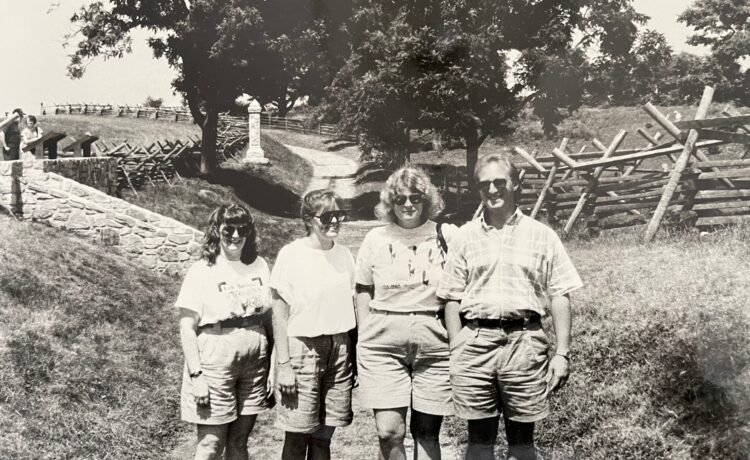
After 35 years of service, Marcia Miller has retired and concluded an accomplished career at the Maryland Historical Trust. We sat down with Marcia and asked her to reflect on her time at MHT, the historic architecture of Maryland, and her exciting retirement plans.

How did you get interested in historic architecture?
After attempting my first ever floor plan in third grade, I decided I wanted to be an architect—an ambition that lasted through high school and even prompted taking my first drafting classes. When I realized I could combine architecture with my love of history, I knew I’d found my true calling. The only question was whether to get my BA in architecture or history before getting a graduate degree in architectural history. Getting my degree in George Washington University’s preservation program set me on the path to MHT and an extremely rewarding career.
Who mentored you or influenced your career?
I was blessed to have mentors who made a true difference in my life and in my career. Richard Longstreth gave me a solid foundation in preservation and his real-world lessons still guide my thinking today. Orlando Ridout hired me straight out of school and was my friend, boss, and mentor for over 20 years. Working side by side with him taught me how to read buildings and maintain the highest standards of fieldwork, and his willingness to share his knowledge shaped my passion for early architecture and survey work. I also owe a great deal to Michael Day whose technical expertise was instrumental during our collaboration on the Old Senate Chamber restoration project.

Did you have any jobs in the field before you were hired at MHT?
I had quite a few preservation jobs before I came to the Trust. I was lucky to get a job in history during college when I worked in the special collections department of the Maryland Historical Society (now the Maryland Center for History and Culture). Between then and finishing my master’s coursework, I did CRM work, worked at the National Register and on a HABS summer team, and worked for a prominent and generous DC historian who took me under her wing. In the summer of 1990, Peter Kurtze and I were contracted by MHT to write the Baltimore City School context. I was hired permanently a few months later and am fortunate to have spent my career at MHT working in the Office of Research, Survey, and Registration (ORSR).
What are some of your proudest accomplishments from your time with MHT? What will you miss most?
I am most proud of maintaining a top-notch and nationally known survey program for so many years. MHT has aways been at the forefront of survey work, and we’ve worked hard to continue the traditions of comprehensive, in-depth fieldwork and recognizing the significance of all types of buildings as well as their builders, owners, and those who labored within them. The Architectural Fieldwork Symposium has been a great success in bringing together the state’s surveyors and highlighting the many projects that exemplify this each year. In terms of individual projects, the restoration of such landmark buildings as the Maryland State House and the Old Treasury building were projects of a lifetime, and I am incredibly proud to have provided oversite and research to both. My most lasting legacy, however, may be the team of stellar professionals I assembled and lead in ORSR, and I know the office will continue to flourish in their hands. I will miss all the amazing people I’ve had the privilege of working with and the connections to buildings and places throughout the state.

What projects are you looking forward to pursuing in retirement?
I’m really looking forward to focusing on my own research and writing, some of which I’ve been working on for 30 years. My work on the craftsmen and builders of early Maryland has come full circle and deserves to be written, as does my more recent research on five-part houses. It’s very fulfilling to revisit these topics with both a more experienced eye and with the new capabilities available for research. I’ve already made several exciting new connections that I can’t wait to share. I also hope to reprint Orlando’s and my book Architecture in Annapolis, and to share these new discoveries.

What is your favorite historic building in Maryland?
This is a hard one; there are too many good buildings in Maryland. I wrote my thesis on the Chase-Lloyd House and it will always be a well-deserved favorite. But really there isn’t just one. Bank barns have always fascinated me, and I really like the farms of Carroll and Frederick counties. One of my fondest memories is of documenting a great little farmhouse, abandoned and standing alone in a field. It was a crisp autumn day with a warm breeze blowing through the broken windows. Ken Short and I spent the day measuring and drawing. The house and its setting were typical of central Maryland, and it even had the painted stairs you often see in the piedmont. You just can’t beat a day like that.

What is your favorite building feature/element, and why?
Recently, I’ve focused on the interior finishes of buildings as I’ve learned more about the traditional processes and artisans who created them. I’ve identified many of the crafts people doing this work in 18th-century Annapolis and am slowly making connections between the two. I’m currently enthralled with plaster entablatures and cornices, as I trace the work of one plasterer from London, John Rawlings, over a fifteen-year career in the city. Another favorite element is staircases; Maryland has a fine tradition of staircase building and I’ve seen some of the best in the region.
What do you see as the future of architectural survey?
Survey work remains vital as the foundation of all preservation work. I am excited about the new technologies that make our work easier; the use of tools like laser scanning and drones can help tremendously in documenting a building while advanced camera equipment and CAD make finishing projects faster and simpler. These new technologies, combined with old-school investigative methods, can unlock great potential for the profession.

Thank you, Marcia, for your commitment to a career in public service with MHT. We wish you a happy and fulfilling retirement!
Discover more from Our History, Our Heritage
Subscribe to get the latest posts sent to your email.