
About a year ago, a certain kind of cinephile took note of obituaries for Ted Kotcheff, a television-turned-film director who worked steadily from the mid-fifties to the mid-nineties. Even to readers only casually acquainted with movies, more than one title pops out from his filmography: The Apprenticeship of Duddy Kravitz, Fun with Dick and Jane, North Dallas Forty, Weekend at Bernie’s. The focus on genres, and their variety, suggests not an auteur but a journeyman, the kind of efficient, versatile problem-solver that used to keep Hollywood afloat. But occasionally, the work of a journeyman can achieve its own kind of transcendence: that moment came with First Blood, in Kotcheff’s case, which launched the Rambo series in 1982.
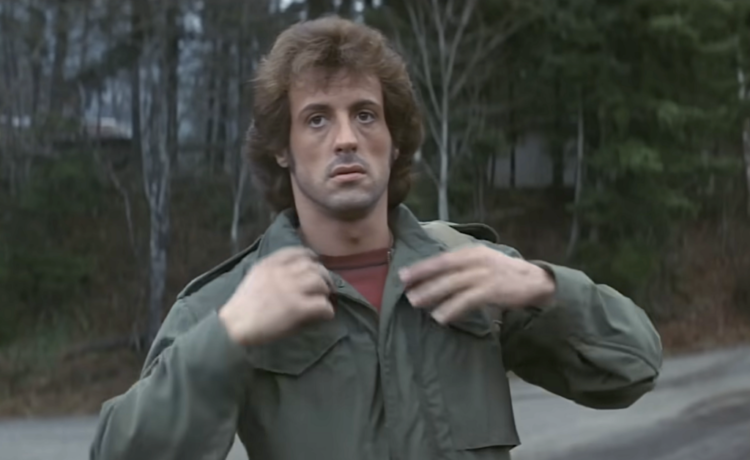
Those who remember Sylvester Stallone’s John Rambo as a headbanded one-man army bent on re-fighting and winning the Vietnam War, one bout of ultra-violence at a time, will be surprised by the relative meekness of his first onscreen incarnation.
As First Blood’s story is summarized by the CinemaStix video above, Rambo drifts into a small Washington town after a search for his Vietnam comrades comes to a fruitless end. Hostilely ejected by the local sheriff, he nevertheless walks right back into city limits. Arrested and booked at the police station, he turns on the cops in a PTSD-triggered rage. When he makes his escape into the forest, the law pursues him, leaving him no choice — at least in his own mind — but to declare war on the police, the town, and perhaps the whole of American civilization.
This is a promising enough narrative for a post-Vietnam genre picture, as a variety of producers must have thought while David Morrell’s original novel was circulating through Hollywood. But only the star power of Stallone, with the first couple of Rocky pictures under his belt, could get it made. And indeed, he almost got it un-made: dismayed by its initial three-and-a-half hour cut, he decided to buy the rights and destroy the negative. The solution that ended up saving the movie wasn’t much less drastic, producing a 93-minute cut that excised most of Rambo’s dialogue. The result, as CinemaStix creator Danny Boyd explains, possesses the good kind of ambivalence, which lets the audience share not just the beleaguered protagonist’s perspective but also that of his increasingly frustrated pursuers, who escalate the battle out of all proportion to his actions. 44 years on, First Blood still offers surprises, not the least of which is that Rambo — for the last time in his career — never actually kills anyone.
Related Content:
How the Vietnam War Shaped Classic Rock–And How Classic Rock Shaped the War
How Editing Saved Ferris Bueller’s Day Off & Made It a Classic
Based in Seoul, Colin Marshall writes and broadcasts on cities, language, and culture. He’s the author of the newsletter Books on Cities as well as the books 한국 요약 금지 (No Summarizing Korea) and Korean Newtro. Follow him on the social network formerly known as Twitter at @colinmarshall.