
Yasujirō Ozu was born in 1903, and made films from the late nineteen-twenties up until his death in 1963. Though not an especially long life, it spanned Japan’s pre- and postwar eras, meaning that in many ways, it ended in a very different country than it began. Not that you’d know it from Ozu’s films, whose distinctive form and style must have changed less through the decades than those of any of his colleagues. For viewers only casually acquainted with his oeuvre, it’s easy to joke that if you’ve seen one of his pictures, you’ve seen them all. But true Ozu enthusiasts, whose numbers have steadily grown all around the world since the filmmaker’s death, understand that each phase of his career offers distinctive pleasures of its own.
In fact, Ozu persisted through sweeping changes in not just world history, but also the history of cinema. His first 34 films were silent, the next fourteen were sound in black-and-white, and his last six were in color. It is to the domestic master’s third act that Tony Zhou and Taylor Ramos have devoted their latest Every Frame a Painting video essay.
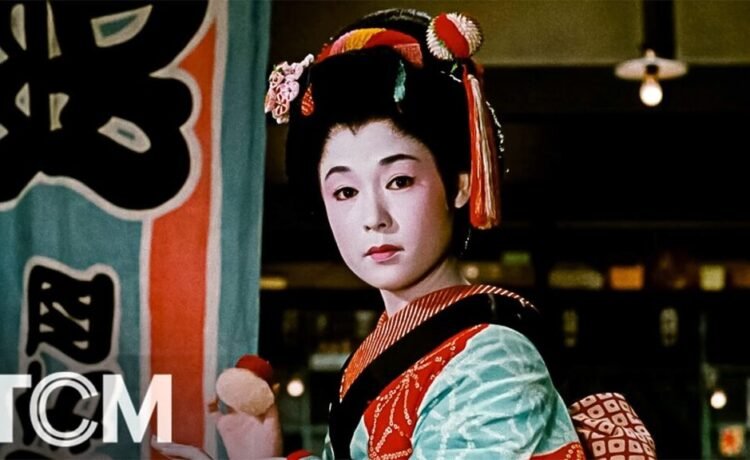
As with most filmmakers, it took Ozu a few years to make color his own: in Equinox Flower, from 1958, “some of the scenes are so bright that it looks like an MGM musical,” owing to his studio’s desire to showcase the actress Fujiko Yamamoto. And it’s not just the hues of her kimono that dominate the images: so does the red of Ozu’s signature teapot whenever it finds its way into the frame.
Ozu’s next color film Good Morning makes use of a “much more natural, earth-toned color palette. The images feel more balanced, and there isn’t one visual element that sticks out from all the others.” In his project after that, Floating Weeds (itself a remake of his 1934 silent A Story of Floating Weeds), he worked with the acclaimed cinematographer Kazuo Miyagawa, who’d also collaborated with the likes of Kurosawa and Mizoguchi. Using strong light and shadow, Miyagawa showed how, “by shaping the light, he could change how colors were perceived,” often in different scenes framed in exactly the same way. At this point, anyone doing an Ozu binge-watch will feel that color itself is being adapted to the rigorous objectivity of his work.
“His films are full of repetitions and small variations,” Zhou says. “He will show the same hallway again, and again, and again.” Seemingly minor elements in one scene match visually with elements in others. “As a result, Ozu’s movies rhyme. One shot will mirror another, one person’s behavior will be repeated,” across not just an individual picture, but his whole filmography. Watch through it, and “you’re struck by how similar two people can be, how often one place resembles another, how life itself is cyclical, and Ozu used color as another way to build these patterns.” Though subtly expressed, these themes would certainly have resonated with audiences in a society forced to reinvent itself after losing the Second World War. Whether Ozu suspected that they could draw even more attention from future generations far from Japan is a question not even his diaries, now the subject of a documentary themselves, can answer.
Related content:
An Introduction to Yasujirō Ozu, “the Most Japanese of All Film Directors”
How One Simple Cut Reveals the Cinematic Genius of Yasujirō Ozu
The Golden Age of Japanese Cinema: Kurosawa, Ozu, Mizoguchi & Beyond
How Master Japanese Animator Satoshi Kon Pushed the Boundaries of Making Anime: A Video Essay
Based in Seoul, Colin Marshall writes and broadcasts on cities, language, and culture. He’s the author of the newsletter Books on Cities as well as the books 한국 요약 금지 (No Summarizing Korea) and Korean Newtro. Follow him on the social network formerly known as Twitter at @colinmarshall.