
Shakespeare’s The Tragedy of Richard the Third begins with the eponymous character uttering the famous line “Now is the winter of our discontent.” It ends at the Battle of Bosworth Field, by which point his villainous schemes have come to ruin and his desertion by Lord Stanley seems to have sealed his fate. “A horse, a horse, my kingdom for a horse,” he cries out, coining another expression used four centuries later before being slain by the Earl of Richmond, the man who would be Henry VII. Though Shakespeare himself was writing more than 100 years after the historical events he dramatized, he included little after the event of Richard’s death, whose most fascinating mystery was in any case only solved in our own time.
You can see the story of Richard III’s long-unknown whereabouts in the Primal Space video above. According to records, says the narrator, “he was buried unceremoniously beneath the Greyfriars Church in Leicester, and a monument was eventually placed above his grave.” When Henry VIII ordered such houses of worship shut down forty years later, Greyfriars was among the institutions demolished.
Everyone eventually came to believe that, amid this destruction, Richard’s body had been exhumed and tossed off the Bow Bridge. Only in the early two-thousands did a search for his corpse commence in earnest, spearheaded by the Richard III Society. Having determined that the Bow Bridge story had been made up, the society’s members then had to pin down the long-confused former location of Greyfriars Church.
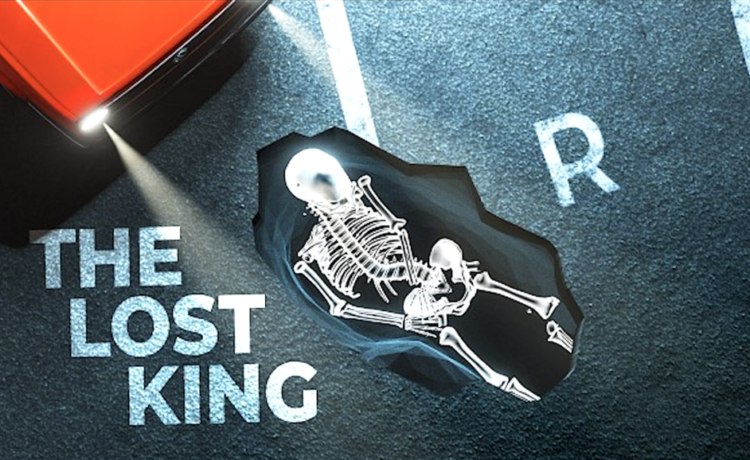
One of them, Philippa Langley, got the hunch to start looking under a Leicester parking lot. Budgetary limitations forced her team to try digging just three trenches across spaces likeliest to cross the church’s footprint. “Amazingly, just six hours into the first day, they came across a skeleton” with skull damage and spinal curvature. Richard was indeed described as a “hunchback” in his lifetime, but in the twenty-first century, only DNA evidence closes the case. Its acquisition necessitated both finding a couple unbroken female lines (the only means of transmitting mitochondrial DNA) from his sister down to living, testable individuals while carbon-dating the skeleton. Sure enough, Richard turned out to have been in eternal repose not just under that parking lot, but near a stenciled letter R — the kind of coincidence from which even the Bard himself might have shied away.
Related content:
Confirmed: The Bones of Richard III (1452–1485) Found Under a UK Parking Lot
How England First Became England: An Animated History
A New Analysis of Beethoven’s DNA Reveals That Lead Poisoning Could Have Caused His Deafness
Based in Seoul, Colin Marshall writes and broadcasts on cities, language, and culture. He’s the author of the newsletter Books on Cities as well as the books 한국 요약 금지 (No Summarizing Korea) and Korean Newtro. Follow him on the social network formerly known as Twitter at @colinmarshall.