
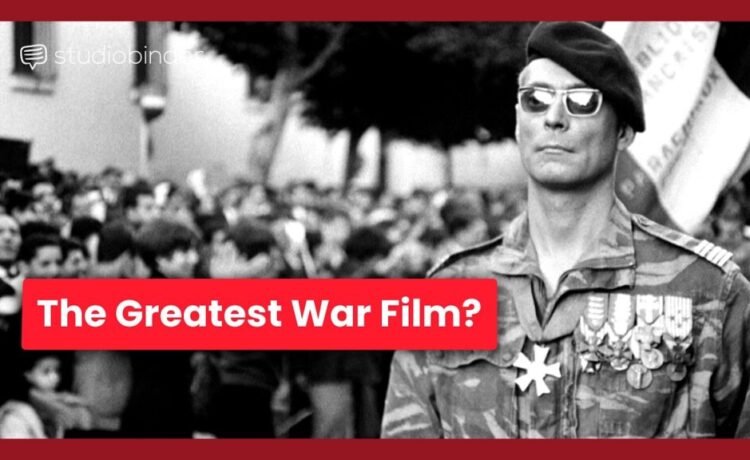
Paul Thomas Anderson’s latest film, the loose Thomas Pynchon adaptation One Battle After Another, serves up many a memorable scene. But for a certain kind of cinephile, nothing — not the terrorist attacks, not the chases, not the swerves into askew comedy — sticks in the mind quite so much as the moment in which Leonardo diCaprio’s stoned protagonist tunes in to a broadcast of Gillo Pontecorvo’s The Battle of Algiers. First released in 1966 (and currently free to watch on YouTube in certain regions), that picture has now been a mainstay of film-studies syllabi long enough that one forgets just how much it would have startled its earliest viewers, more than a few of whom had no idea whether they were watching a war movie or genuine Algerian War newsreel footage.
Some of those viewers included major filmmakers, not least Stanley Kubrick, who later described all films as “false documentaries,” and Pontecorvo’s work as an especially impressive example thereof. Anthony Frewin, who worked as Kubrick’s personal assistant, remembers the director telling him that “I couldn’t really understand what cinema was capable of without seeing The Battle of Algiers. He was still enthusing about it prior to his death.”
The new StudioBinder video at the top of the post also includes testimonials from a host of other auteurs including Werner Herzog, Steven Soderbergh, Oliver Stone, Alfonso Cuarón, Spike Lee, Mira Nair, and Christopher Nolan.
Kathryn Bigelow — who, as the director of pictures like The Hurt Locker and Zero Dark Thirty, knows something about spinning recent military conflicts into compelling, realistic thrillers — pulled The Battle of Algiers from the shelves on her visit to the Criterion Collection’s closet. She calls it “probably my favorite movie of all time,” adding that “the metronome of tension is almost insufferable, but I say that as a compliment.” A young Roger Ebert, in his contemporary review of the film, warned that it “may be a deeper film experience than many audiences can withstand: too cynical, too true, too cruel and too heartbreaking. It is about the Algerian war, but those not interested in Algeria may substitute another war.”
Such a “universal frame of reference” is also common to the other highlights of the Italian neorealist movement, which also include Roberto Rossellini’s Rome, Open City, Vittorio De Sica’s Bicycle Thieves, and Luchino Visconti’s The Earth Trembles, with their stark black-and-white cinematography, their real, often still war-torn locations, and their mostly non-professional actors. Despite their venerability, these films can remind even us twenty-first-century viewers who feel as if we’ve seen it all just how much cinematic potential remains untapped. As Paul Thomas Anderson puts it, “It’s always a good idea to watch The Battle of Algiers again, just as a cinematic exercise to get you excited” — no alteration of consciousness required beforehand.
Related content:
Stanley Kubrick’s List of Top 10 Films: The First and Only List He Ever Created
Fear and Desire: Stanley Kubrick’s First and Least-Seen Feature Film (1953)
How Postwar Italian Cinema Created La Dolce Vita and Then the Paparazzi
Animated Introductions to Edward Said’s Groundbreaking Book Orientalism
Based in Seoul, Colin Marshall writes and broadcasts on cities, language, and culture. His projects include the Substack newsletter Books on Cities and the book The Stateless City: a Walk through 21st-Century Los Angeles. Follow him on the social network formerly known as Twitter at @colinmarshall.