

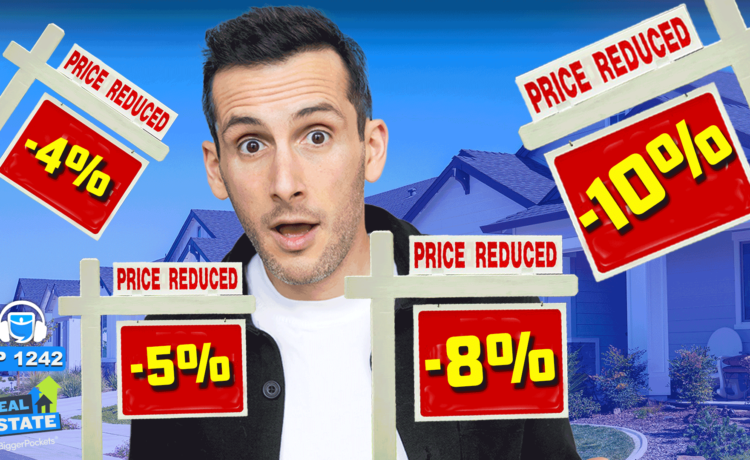
At this point, nobody can refute that a full-on buyer’s market has arrived. Homes are selling below list price, buyers are waiting out the market, and sellers are getting increasingly desperate. All the while, mortgage rates are a full percentage point lower than a year ago, inventory is up, and mortgage payments are actually down.
In this month’s housing market update, we’ll get into it all—how much of a discount you can get on your next property (and markets with the biggest deals), why nobody is buying right now and how that gives investors an advantage, whether mortgage rates will drop below the low six-percent range, and how likely a housing market crash is with inventory rising but demand staying stagnant.
Dave:
The full on buyer’s market is coming for real estate right now. Home buyers are seeing the biggest discounts in more than 12 years, and this is what we’ve all been waiting for. There are deals to be found right now if you’re an investor and in this February housing market update, I’ll tell you how and where to find. Hey everyone, it’s Dave Chief investment Officer at BiggerPockets Real estate investor for 16 years and a professional housing market analyst. And being a housing market analyst is starting to be a little bit fun again these days because there’s so much going on and these are things investors should be paying close attention to because these shifts in market dynamics mean opportunities, specifically opportunities to buy and build out your portfolio. These are the types of changes that we like to see and that we have been waiting for.
So today we’re doing our February housing market update and in it I’m going to cover the full on shift to a buyer’s market that is making deals easier to find. We’ll talk about inventory news that will tell us where the market might be heading next, we’ll of course do a mortgage rate update and my forecast for rates going forward, plus I’ll share my February risk report where I’ll share data that helps you take advantage of the opportunities that are presenting themselves without exposing yourself to the risks that can come in a buyer’s market. So let’s get to it. First up we’ll talk about the big picture, which is this. The housing market is increasingly a buyer’ss market. Now this doesn’t mean that everything is perfect far from it, but it does mean that deals are going to be easier to find, and this isn’t just my opinion or anecdotal evidence, we actually see real evidence of this in the data.
First, we’re going to start by talking about pricing. Home prices are up as of now about 1% year over year, and this is right within the range we’ve been predicting for 2026 where I’ve said things would remain pretty flat and flat is exactly what we’re getting right now, but that 1.2 increase, although it is up in nominal terms, it’s actually below the pace of inflation and below wage growth. And that means when you consider all those things together, that affordability in the housing market is finally getting better. This is something we have been waiting for 2, 3, 4 years now. In fact, Zillow just put out their January, 2026 market report and they found that the typical monthly mortgage payment is now 8.5% lower than it was a year ago. That’s a lot. I know people are still waiting for rates to come down, but 8.4% lower on a mortgage rate is pretty good.
Of course, it is not a solution to affordability. We have a long way to go there, but this is good news for investors and homeowners alike. Things are getting less expensive to buy on top of improving affordability. The biggest headline in the housing market this month, at least in my opinion, comes from a new Redfin report that shows that buyers are actually scoring the biggest discounts since they started keeping this data. It’s only about 12 years, so it’s not going that far back in time, but still that is really good news for anyone who’s trying to build their portfolio. Right now, according to the report, the average buyer is now getting a 3.8% discount off list price. That might not sound that big, but since the median home price right now is over $400,000, that’s about a $16,000 discount on the average property. That means serious equity that you could just be walking right into, and this is something I feel like everyone listening right now should be paying attention to because this right here, this is the benefit of a buyer’s market.
It comes with some downsides of course, like slower appreciation, but our jobs as investors is just to take what the market is giving us and what it is giving us is discounts, and that’s something I will definitely be taking advantage of. Just consider this other finding from Redfin. In the same study, it shows that for people who negotiate below list, because not everyone’s going to do that, but for the people who actually go out and find deals where they can get them under lists, they work with motivated sellers, those people are actually getting discounts of almost 8% off list price. Or if you factor in the average home price, that’s more than $32,000. This is for me the number one shift in tactics. Investors should be thinking about right now. Negotiate being patient, finding sellers who want to move their property quickly because when you find them, there are significant discounts to be had, which can boost your profits on pretty much any acquisition.
Now of course, not all markets have big discounts, but most markets have at least some. The biggest discounts we’re seeing are in Florida and Texas. Not a huge surprise here, but those markets are seeing 10% plus discounts. But even in hotter markets, the markets that have and are still growing like the ones in the northeast and the Midwest, they’re also seeing discounts. Some of the hottest markets in the last couple of years like Milwaukee or Indianapolis, discounts off list are still three to 5%. So to me, everyone, no matter where you’re offering on your next offer, you should be thinking about how do I get this significantly off list price? And even better than that, you don’t just want to get it below list price. You want to get it below market comps because some of these discounts, some of the reason we’re seeing these big discounts is not because home prices are actually falling.
It’s because sellers haven’t really accepted reality. They haven’t really priced appropriately to the market. So not only should you be looking under list price, but work with your agent, do your own comps if you need to and figure out what each property is really worth. Try to buy it three, five, 7% below what current comps are. That to me is the single best way that you can protect yourself in a buyer’s market while still taking advantage of the better and better deals that we’re seeing. So that’s big news to me. The fact that discounts are coming, affordability is getting better, this is good news for the housing market. But before we move on to talking about inventory, I want to be clear that not everything is great in the housing market. I think we all know that. I don’t think we’re really in a healthy market just yet.
We’re moving towards it a more balanced market in terms of supply and demand, but we’re not doing very well in terms of sales volume, the total number of homes that are actually selling. In fact, in January we went backwards. As of January we’re on pace for only 3.9 million home sales, which is below where we were in 2025, which was already a very slow year. We’re basically back down to where we were in late 2024, which if any of you remember was not a great time for the housing market. Just from December to January alone we saw home sales drop 8.5%, which is the biggest monthly decline since February, 2022. This isn’t good for a healthy market. We need more sales volume. I think any agent, any loan officer, any investor or seller knows that we just need more volume and activity in the housing market for it to be healthy.
We want to be somewhere near 5 million, five and a half million. That’s a normal market. We’re at 3.9 right now, so we definitely have a ways to go. And the thing about this is that normally you would think since affordability is improving, we’d have some better sales volume, but I think there are probably two things getting in the way of housing market activity picking up. The first is just general consumer sentiment. It’s low. If you look at any of the many ways we measure consumer sentiment or confidence in the US, it’s not very good. People are worried about layoffs, they’re worried about inflation, they’re worried about AI taking their jobs. There’s a lot going on and when people are worried they don’t make big purchases like buying a house. So that is definitely one thing that’s going on. But the good news is the other thing that I think is probably suppressing activity is only temporary.
It may sound trivial, but I think that massive snowstorm and cold that swept over a lot of the country over the last couple of weeks definitely slowed down housing market activities, these types of events can really slow down the market. I think some of that did happen in January. My bet is that we actually see an uptick in home sales in February because people can actually leave their house, they can go on home sellings and not freeze. So hopefully get back to that four, 4.1 million pace that we were at before January. So that’s where we’re at with general housing market news. And I just want to reiterate that as we’ve been saying for months 2026, the most likely course it’s going to take is what I call the great stall. Basically we’re going to see housing prices be a little bit flat when mortgage rates come down a little bit, wages go up and affordability slowly improves. That was my thesis I presented back in September, October. I’ve been talking about it for a while and that’s bearing out as we speak and I know the great stall. It doesn’t sound like the most exciting thing, but I think this is positive. The gradual return to affordability, better discounts. These are positive signs, but is that going to continue for the rest of the year to understand what happens next? We need to look at inventory and how it’s trending and we’re going to do that right after this quick break.
Welcome back to the BiggerPockets podcast. I’m Dave Meyer delivering our February housing market update. Before the break, we talked about how we are in the great stall prices relatively flat, but we’re seeing slow and steady improvement to affordability and big discounts, all positive news for investors. Now that we understand what’s going on today, we’ll start to look forward a little bit and examine inventory and mortgage rates. Those are going to tell us what happens next. We’re first going to dive a little bit into inventory at the end of January, 2026. Overall inventory across the whole country was up 10% over the year before. And just as a reminder, in the housing market, what we really care about is year over year data. It’s very seasonal, so what happens from December to January is less important than what happens from January, 2025 to 2026. And what we’ve seen is a 10% increase.
That’s growth inventory going up is a sign that we’re moving towards a buyer’ss market, but we’re not in any sort of crash territory. In fact, we’re still 18% below where we were in January, 2019, which is kind of the last normal housing market that we have to compare to. So definitely a softer market than we were a year ago, but well within normal range. And I dug into a little bit more of this data just trying to compare January 19 to January 26th because again, that’s last normal housing market to today. And what you see for most of the country is actually that we’re still well below 2019 levels basically all of the northeast, all of the Midwest, a lot of California still below where we were in the last normal market. And in fact, if you look at the Midwest, the difference is really dramatic still, even though you see these headlines that inventory is rising in a lot of the Midwest, you still see markets where inventory is 50 or up to 80% below where it was in 2019.
That is not a trivial difference and it’s certainly a sign that a crash is not imminent. Now in the southwest, the story is totally different. If you look at San Antonio is the highest inventory growth up 52%. Florida is up 60%, Denver is up 33%. So these are significant increases and it’s why you see prices falling in those areas. I’m bringing this up because I want everyone to remember when you hear headlines that inventory is up or it’s down. It is super market specific and what you want to look for in your own market is changes in recent inventory. If I were you and researching a market, the two numbers I would look at is the difference between inventory in 2019. And now you can look this up on Redfin, by the way, it’s free just Google Redfin data center, you can go check this out.
And then the difference between inventory between last year and this year, year over year data, that’s what’s going to tell you what’s going on in your market. If inventory is climbing fast, that means better deals and bigger discounts, but it also means prices could drop. There’s a bigger chance that prices fall in areas where inventory is going up. That’s how a buyer’s market works. And of course the opposite is true. If inventory is shrinking yet fewer deals harder to find things at pencil. But if you find something that works, you probably will get more appreciation. Just as an example, San Francisco actually has falling inventory, right? Probably because of the AI boom, it’s minus 6% in the last year, prices are going up there, whereas in Seattle inventory is up 30%. Housing prices here are pretty flat or declining just a little bit. Now there’s no reason you can’t invest in either type of market, but it should change the way that you’re underwriting your deals.
If I’m buying a deal in Seattle, I’m going to be looking for steep discounts and I’m going to underwrite for low appreciation. On the other hand, if I’m buying in Jacksonville, Florida also showing inventory declines, I will underwrite for better price growth, but I’m going to have to be more aggressive in my offers because there’s going to be less motivated sellers. So these numbers, inventory numbers, the number one thing you want to look at. If you want to understand where your market is heading and how to formulate your strategy based on current market conditions. The other thing we need to look at of course, if we’re trying to figure out where the market’s going for the rest of year is mortgage rates. This isn’t really regional, but because of where we are nationally with affordability levels, rates are going to provide a lot of headwinds or tailwinds to pretty much every market depending on which way they move.
So we’re going to talk about this just a little bit. As of today, rates are sitting around 6.1% for a 30 year fixed rate mortgage, right where I predicted the average would be for 2026. Now, I know for some people this might not feel like the most inspiring number out there, but I want to remind people that we are down a full 1% since last year. It was above seven just a year ago, and that changed just 1% in mortgage rates. Means that in an average deal you’re probably getting hundreds of dollars in better cashflow and that really can make the difference between certain deals penciling or not. So overall that is positive news. Affordability again, is getting better, but to be real with all of you, and you probably already know this, I don’t think rates are coming down that much more anytime soon unless something really dramatic happens in the economy.
I do believe the Fed will cut rates again some point this year, maybe not that soon and maybe not that much. But even if they do, there’s just a lot of other things, a lot of uncertainty in the economy that will prevent rates from falling much more. My prediction for the year is not changing. I said at the beginning of the year that rates are probably going to stay between five and a half and six half percent per year and they would average around 6.1%. That is still my forecast and that is still okay. In fact, I believe the fact that rates are more stable is just a good thing. The fact that we aren’t thinking every single month our rate’s going to shoot up or go down is good news for investors. It allows us to predict what’s going on. It means you’re not sitting around wondering, should I go out and pull the trigger on this deal?
Or are rate’s going to be a quarter percent or a half percent lower in a month? They’re staying relatively stable and for me, whether we’re talking about pricing or mortgage rates, stability breeds the right conditions for making good deals for good underwriting. And so I am relatively happy that mortgage rates aren’t swinging wildly anymore. And yeah, sure, I wish they were a little bit lower that would probably breathe some life into the housing market. But I just want to remind everyone that relatively high rates, they’re not even that high by historical standards but higher than we’ve had. They’re definitely high compared to the last 10 years or so. Relatively higher rates can help prices move down, which improves affordability in its own right. And arguably I would say that it improves affordability in a more sustainable way. If rates come down fast, we’ll just see ourselves in another affordability crisis in a few months or years because prices will just go up.
And even if we have lower rates affordability, that will be sort of a moot point. So just overall with mortgage rates looking forward, probably not much of a change in my opinion. Meaning what you see is what you get. Look for deals, given where rates are today, analyze them using the BiggerPockets calculators and find one that works. Right now the market is steady, which means you’re in a good position to underwrite accurately. And that’s exactly what I recommend you doing. As I mentioned before, there is opportunity right now because we are in a buyer’s market, but there’s always a risk that a buyer’s market turns into a crash when inventory starts to go up, when there’s potentially less demand. It’s a balance that you need to keep an eye on. So I’m going to share with you my monthly risk report that examines exactly risks exist in the market so you can help mitigate them and avoid them. And we’ll get into that right after this break.
Welcome back to the BiggerPockets podcast. I’m Dave Meyer giving you my February housing market update. Before the break we talked about inventory and mortgage rates. I don’t really think mortgage rates are moving all that much inventory is going up, which means deals are going to be more abundant and we are moving towards a buyer’s market and for most of us investors, we want a buyer’s market, but we don’t want that buyer’s market to extend so far that it goes into a crash or we see significant home price declines. I think that’s probably something we can all agree on. We want more deals, but we don’t want a crash. So even though we’re seeing more deals, we need to at the same time assess what the risks of a crash are. Now, as a reminder, I know there’s a lot of fear mongering out there about what can cause a crash, but basically it comes from basic economics.
You have to have an imbalance between supply and demand. You need significantly more supply than demand. That is what creates the conditions for a crash. And so how would we potentially move from where we are today, which is relatively balanced, tilting towards a buyer’s market to a crash? We need to see either demand evaporate, buyers just leave the market, or we need supply to go up. We need a lot more people trying to sell their home or some combination of both. So let’s look at those. Are those things happening in the market today? When you look at the demand side, it is not very strong. You don’t have 3.9 million home sales in a market where there is strong demand. But the good news is that it’s pretty stable. And if you look at the data, it’s actually up a little year over year. We did have a little setback in January, but if you look at mortgage purchase applications, I’m personally not super worried right now that demand is going to evaporate.
I know people like to say that there are no home buyers, but it’s sort of stable right now because even though demand is relatively low, so is supply, it’s both relatively low and that means the market is somewhat in balance. To me, the bigger risk, at least as of today for a crash, would be a big increase in supply. Either tons of people list their properties for sale all at once, which also isn’t happening. If you look at new listing data, they’re actually down year over year. So all those crash bros saying people are selling in droves, not really true. It’s actually down 2% year over year. So that is another positive sign that although we’re in the buyer’ss market, we are not coming close to a crash. But the other thing you have to keep an eye on is something called forced selling. This is basically when people are no longer paying their mortgage, they are delinquent and they are get foreclosed on and that can increase inventory.
This is similar to what happened in 2008, and this is really what can create a foreclosure issue in the market. I want to remind people that prices going down does not lead to a foreclosure crisis. It doesn’t lead to this increase in supply that could cause a crash. What leads to that is people not paying their mortgage. You don’t get foreclosed on because your mortgage goes underwater. That is a common misconception. That is not how it works. You can only be foreclosed on if you stop paying your mortgage. And that’s why in this risk report, I always focus a lot on foreclosure and delinquency data. And I do have some new data to share with you. This actually came out from the New York Fed a couple of weeks ago, and what it shows is that transition rates from mortgages are still quite low. Transition rates basically means from paying your mortgage as agreed to being some sort of delinquent.
Now, they’ve definitely gone up from 2021, but they’re at about 1%, which is also where we were from 2014 to 2020. And I know there’s a lot of news showing that foreclosures are up and delinquencies are up. And it’s true, they’re up from pandemic lows because of course they are. There was foreclosure moratoriums during the pandemic. So seeing them come back up from that artificially low level is not a concern. In my opinion, they are right in line with historic norms. Could that change if unemployment spikes to 10%? Yeah, it definitely could. But employment, we just got the data the other day. Unemployment is relatively low right now it’s at 4.3%. And there just isn’t evidence really that this is going to happen. If you hear it is it’s just speculation. It is not evidence. The reality is that people still have super low mortgage rates and they have high credit scores.
People can and are paying their mortgages, which means the risk of a crash remains very low. So overall, just to summarize our housing market update, what we got for you today is that better deals are here and I think more are on the way. This is showing in the data as we are seeing with bigger discounts, higher inventory. And I’m also just seeing this anecdotally, I have the great fortune of talking to a lot of investors from all around the country who are doing everything from flips to burrs to co-living. And I’ve just noticed in the last two or three weeks, honestly, second half of January, first couple of weeks of February, I have been hearing people excited for the first time in a while. I keep hearing that they’re seeing great deals right now and are loading up for people who buy a lot are starting to load up.
And so this is great news as an investor, we haven’t seen these kinds of buying conditions, I think like three or four years even in the hot markets. Inventory is rising, which I think means that we’re going to get flatter markets, more stable conditions. And again, those are the conditions you need to be able to underwrite. Well, stable is good. It means less guesswork. It means that you can put better assumptions into the BiggerPockets calculator when you’re going and analyzing your deals. And this is something I think every investor should be taking advantage of. So my advice, keep your eyes open. There’s still going to be a lot of junk out there. Don’t get me wrong. There’s not all of a sudden just amazing deals everywhere. There’s still a lot of things that are overpriced. You need to be patient, you need to negotiate. You need to use the tactics and strategies that we talk about in the upside era during the great stall period that we’re in.
And if you do that, you are going to be able to find better and better deals. And the good news is, even though those discounts are coming, the risk of a full on crash remains relatively low. So get out there, look for deals, negotiate, be patient, buy under market comps. These are the keys to finding great deals right now, and I assure you those deals are here and more are coming. That’s what we got for you today in our February housing market update. Don’t forget to subscribe to the podcast on Apple or Spotify or on YouTube to ensure you don’t miss any updates that help you gain an edge in your investing. Thank you all so much for listening. I’m Dave Meyer and I’ll see you next time.
Help us reach new listeners on iTunes by leaving us a rating and review! It takes just 30 seconds and instructions can be found here. Thanks! We really appreciate it!
Interested in learning more about today’s sponsors or becoming a BiggerPockets partner yourself? Email [email protected].