
The saying “You can’t take it with you” may be a cliché to all of us here in the twenty-first century, but it would hardly have made sense to an ancient Egyptian. One of the most widely known qualities of that civilization’s upper crust, after all, is that its members spared no expense trying to do just that. The most compelling evidence includes the tombs of the pharaohs, lavishly stocked as they were with everything from daily necessities to religious artifacts to servants (in effigy or otherwise). And nobody who was anybody in ancient Egypt would be seen shuffling off this mortal coil — or whatever the shape in which their poets cast it — without a Book of the Dead.
“A standard component in Egyptian elite burials, the Book of the Dead was not a book in the modern sense of the term but a compendium of some 200 ritual spells and prayers, with instructions on how the deceased’s spirit should recite them in the hereafter,” writes the New York Times’ Franz Lidz.
“Compiled and refined over millenniums since about 1550 B.C.,” the text “provided a sort of visual map that allowed the newly disembodied soul to navigate the duat, a maze-like netherworld of caverns, hills and burning lakes.” Each of its “spells” addressed a particular situation the deceased might encounter on that journey: a snake attack, decapitation, a turning upside down that “would reverse your digestive functions and cause you to consume your own waste.”
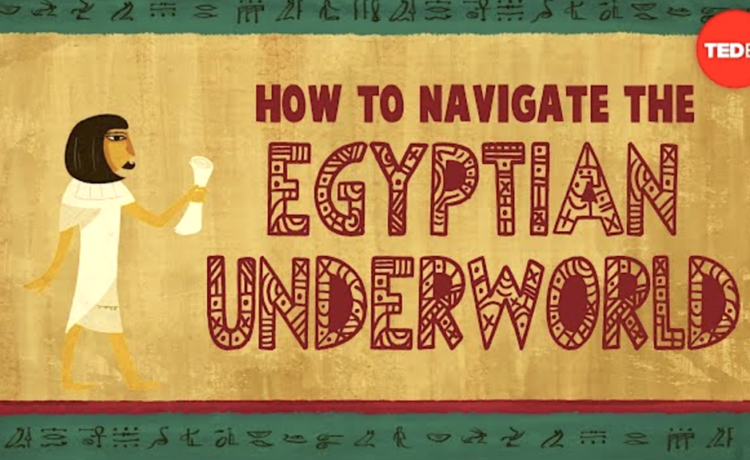
We can certainly understand why these high-status ancient Egyptians didn’t want to take their chances. In the animated Ted-ED video above, you can follow the journey of one such individual, a scribe from thirteenth-century-BC Thebes called Anees. After his body undergoes two months of mummification, his spirit makes its harrowing journey through the underworld, calling upon the spells he’d thought to include in his Book of the Dead when alive. Then comes moral judgment by a battery of 42 “assessor gods” and a weighing of his heart, the final step before his admittance to a lush wheat field that is the Egyptian afterlife. Whether Anees got that far remains an open question, but modern physical and digital enshrinement of Books of the Dead (more of which you can see up-close at Google Arts & Culture), has granted him and his compatriots a kind of immortality after all.
Related Content:
Hear Laurie Anderson Read from the Tibetan Book of the Dead on New Album Songs from the Bardo
When the Grateful Dead Played at the Egyptian Pyramids, in the Shadow of the Sphinx (1978)
Based in Seoul, Colin Marshall writes and broadcasts on cities, language, and culture. He’s the author of the newsletter Books on Cities as well as the books 한국 요약 금지 (No Summarizing Korea) and Korean Newtro. Follow him on the social network formerly known as Twitter at @colinmarshall.