
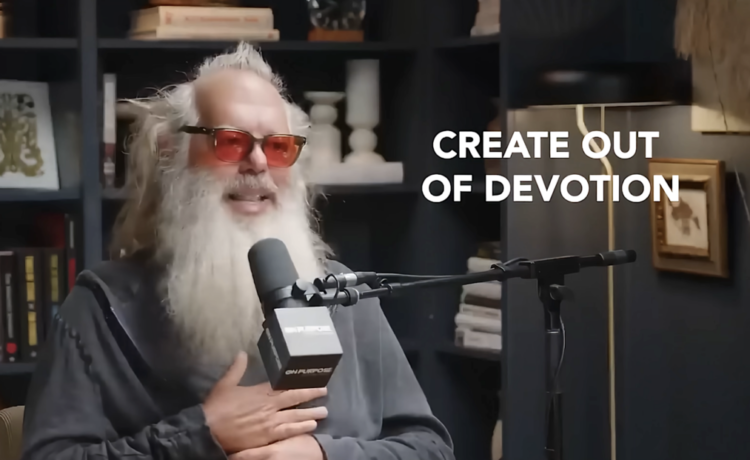
If you’ve heard Run‑D.M.C.‘s Raising Hell, Rage Against the Machine’s self-titled debut, Johnny Cash’s American Recordings, or Adele’s 21, you’ve heard the work of Rick Rubin. Yet even if you’ve listened closely to every song on which he’s been credited as a producer over the past 45 years, you may have trouble pinning down what, exactly, the work of Rick Rubin is. Though his résumé includes such professional achievements as co-founding both Def Jam Recordings and American Recordings, as well as sharing the presidency of Columbia Records for a stretch, he’s become best known in recent years as a kind of barefoot sage of creativity.
Rubin has proven ready to dispense sometimes-cryptic wisdom in whatever contexts he finds himself, and in the twenty-twenties, that role naturally involves appearing on a lot of long-form interview podcasts.
For Rubin in particular, the publication of his book The Creative Act: A Way of Being constituted an incentive — or perhaps an excuse — to take a seat across from popular podcasters like Lex Fridman, Jay Shetty, and Andrew Huberman. Naturally, these conversations spend a good deal of time on questions of what it takes to create a work of art, great or otherwise, in music or whichever medium it may be.
One of the most surprising points to which Rubin returns again and again is that the best art is never made to please an audience. Instead of trying to anticipate the tastes of others, you must first satisfy yourself with your work. Think back to your first encounter with your very favorite albums, films, or books, and you’ll realize the truth of Rubin’s words. Even then, it must have felt like the musician, the director, or the author didn’t guess what you wanted, but worked to create something personally resonant that went on to resonate with you — and, perhaps, millions of others as well.
The factors involved in such an artistic connection are many and inscrutable, in Rubin’s telling, and attempts at their explanation tend to verge on the mystical. But they can’t be reduced to a formula that applies always and everywhere, which means that creators of all kinds have to go through experience after long experience of trial and error throughout their careers. For many, this can necessitate getting a day job, Rubin’s advocacy of which puts him at odds with another of the most famous music producer/gurus of all time. But then, there’s more than one way to get creative in this world.
Related content:
Rick Rubin: The Invisibility of Hip Hop’s Greatest Producer
The Beastie Boys & Rick Rubin Reunite and Revisit Their Formative Time Together in 1980s NYC
Rick Rubin Revisits the Origins of Def Jam Records & the NYU Dorm Room Where It All Began
Malcolm Gladwell and Rick Rubin Launch a New Music Podcast, Broken Record: Listen Online
Based in Seoul, Colin Marshall writes and broadcasts on cities, language, and culture. He’s the author of the newsletter Books on Cities as well as the books 한국 요약 금지 (No Summarizing Korea) and Korean Newtro. Follow him on the social network formerly known as Twitter at @colinmarshall.