
“Good evening,” said Alfred Hitchcock to the television viewers of America on March 25, 1959. “Tonight I’m dining at my favorite club. There are many advantages here. As you can see, informality is the rule. There is also the stimulation of intellectual companionship without the deafening quiet that pervades most clubs. Best of all, I like its privacy: only four persons are allowed at a table, and, of course, no one pays any attention to you.” This was an example of the deadpan irony with which the filmmaker introduced each broadcast of Alfred Hitchcock Presents, for the “club” of which he spoke was clearly an automat. Today, many readers under about 50 will never have heard the word, but at the time, it referred to a seemingly permanent institution in American life.
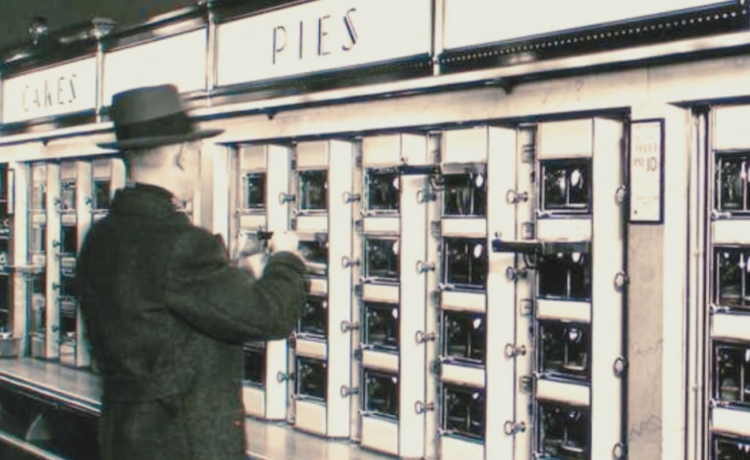
Or rather, an institution of urban American life, and above all in two cities, Philadelphia and New York. There, no one could think of automats without thinking of Horn & Hardart, in its heyday the largest restaurant chain in the world. The concept, which co-founder Joseph Horn imported over from Berlin in the early nineteen-tens, was of a restaurant with no waiters: rather, you could choose your dish à la carte from a wall of coin-operated compartments, paying the nickel or two that would allow you to take the food inside.
Salisbury steak, creamed spinach, baked beans, a ham-and-cheese sandwich, macaroni and cheese, chocolate pudding, strawberry rhubarb pie: whatever it was, the behind-the-scenes staff would replace it just as soon as you put the last one on your tray.
Smack of modernity though it once did (and in a way, still does), the term automat is somewhat misleading. We might describe the experience of visiting one as dining inside a giant vending machine, but the actual running of the operation was quite labor-intensive. Most of the work was performed out of the customer’s sight, as far away as in the large central commissaries that prepared many of the dishes to be transported daily to Horn & Hardart’s 88 locations. This sheer scale of operation allowed the chain to offer some of the cheapest meals commercially available, with the result that its automats boomed even — indeed, especially — during the Great Depression. Their economic barrier was low, and of sex and race, nonexistent; those who remember them describe them becoming some of the most democratic institutions in postwar America.
You can hear such memories recalled in the recent documentary The Automat by figures like Ruth Bader Ginsburg, Colin Powell, and Mel Brooks, who rhapsodizes about Horn & Hardart’s coffee, dispensed for just a nickel from elaborate dolphin-headed spigots. That degree of detail was standard in the interiors, whose marble, chrome, and glass look palatial by the standards of the fast-food joints that ultimately replaced the automat. That glory was one casualty of postwar suburbanization and hollowing-out of central cities that resulted. What with the American urban renaissance of the past few decades, attempts have been made to revive the automat concept, but perhaps, as Brooks puts it, “the logistics and the economics of today won’t allow anything that simple, naïve, and eloquent and beautiful to flourish again.” Ordering a meal brought straight to your door may be more convenient, but even delivery-app addicts have to admit that it will never have the same romance.
Related content:
How Edward Hopper’s Paintings Inspired the Creepy Suspense of Alfred Hitchcock’s Rear Window
Watch the “Biblio-Mat” Book-Vending Machine Dispense Literary Delight
How Fast Food Began: The History of This Thoroughly American (and Now Global) Form of Dining
Based in Seoul, Colin Marshall writes and broadcasts on cities, language, and culture. He’s the author of the newsletter Books on Cities as well as the books 한국 요약 금지 (No Summarizing Korea) and Korean Newtro. Follow him on the social network formerly known as Twitter at @colinmarshall.