
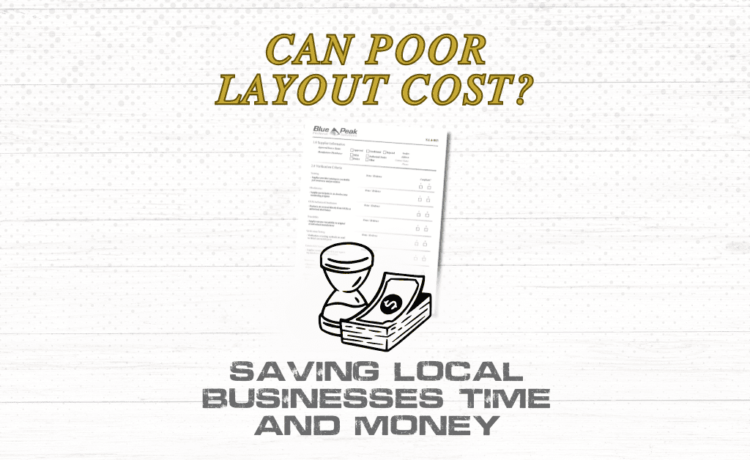
Poor layout is rarely treated as a business problem. It is often dismissed as cosmetic or subjective. In reality, layout decisions directly affect how information is processed, acted on, and corrected. For local businesses, those small inefficiencies compound into real operational cost.
When layout fails, time is lost explaining, correcting, and redoing work that should have been clear the first time.
Why layout is an operational issue, not a visual one
Layout controls how information flows. When structure is unclear, people hesitate, make assumptions, or ask questions that interrupt work.
What layout actually influences
How quickly information is found
How accurately instructions are followed
How often clarification is required
How confident customers feel taking action
Poor layout introduces friction at every step.
Time lost to repeated clarification
One of the most common costs of poor layout is repeated explanation.
Where clarification time appears
Phone calls about invoices
Emails asking how to complete forms
Staff explaining printed materials
Customers misunderstanding next steps
Each interruption may seem small, but together they consume hours every week.
Errors caused by misread or overlooked information
When layout does not guide attention, critical details are missed.
Common layout-related errors
Totals overlooked on invoices
Dates or deadlines missed
Incorrect form fields completed
Instructions skipped or misunderstood
These errors lead to rework, corrections, and sometimes refunds.
Inconsistent documents slow internal workflows
Inconsistency forces staff to reorient every time they open a document.
How inconsistency creates drag
Different layouts for similar tasks
Changing terminology across documents
Unpredictable placement of key information
No visual standard to rely on
Consistency reduces cognitive load and speeds up routine work.
Poor hierarchy hides what matters most
Hierarchy tells the reader what is important and what can wait.
Signs of weak hierarchy
Everything appears equally important
Headings do not stand out
Key numbers blend into surrounding text
Calls to action are unclear
Without hierarchy, readers scan randomly instead of following a path.
Layout problems increase revision cycles
Documents with unclear structure require ongoing adjustment.
Why revisions multiply
Changes are made without a clear framework
Updates break existing alignment
New information is added wherever space exists
Documents grow more cluttered over time
Each revision takes longer than the last.
Flyers and handouts that fail to convert
Marketing materials suffer from layout issues as much as internal documents.
How layout affects effectiveness
Messages are buried instead of highlighted
Too many ideas compete for attention
No clear entry point for the reader
Important details are overlooked
Poor layout wastes printing costs and opportunity.
The hidden financial impact of layout issues
Layout problems rarely show up as a single expense. They appear as accumulated loss.
Where money is quietly lost
Staff time spent correcting mistakes
Delayed payments due to invoice confusion
Reprints and material waste
Lost opportunities from unclear communication
These costs add up over time.
What effective layout does differently
Effective layout supports how people read and work.
Characteristics of effective business layout
Clear visual hierarchy
Consistent structure across documents
Intentional spacing and alignment
Logical sequencing of information
Predictable placement of key details
These choices reduce friction without changing content.
When layout should be reevaluated
If staff routinely explain documents, if customers make the same mistakes repeatedly, or if revisions never seem to end, layout is likely contributing to the problem.
Closing
Poor layout costs local businesses time and money by creating confusion, errors, and unnecessary rework. Clear, structured layout improves efficiency, reduces interruptions, and protects both staff time and customer trust.
In many cases, improving layout is not about redesigning from scratch, but about restructuring existing materials so information works the way people expect.

Ronnie Lee Roberts II is a part owner and principal of R.L. Roberts II Design, LLC, a design and documentation studio focused on production-ready graphics and structured compliance materials. His background combines quality management, technical documentation, and professional graphic design, supporting work built for operational use rather than presentation alone. His portfolio includes sign shop overflow support, naval base maps and facilities graphics, home service company materials, and custom compliance documentation, along with work for mission-driven organizations such as The Arc and United Way. His work emphasizes clarity, consistency, and efficiency across print, digital, and regulated environments.