
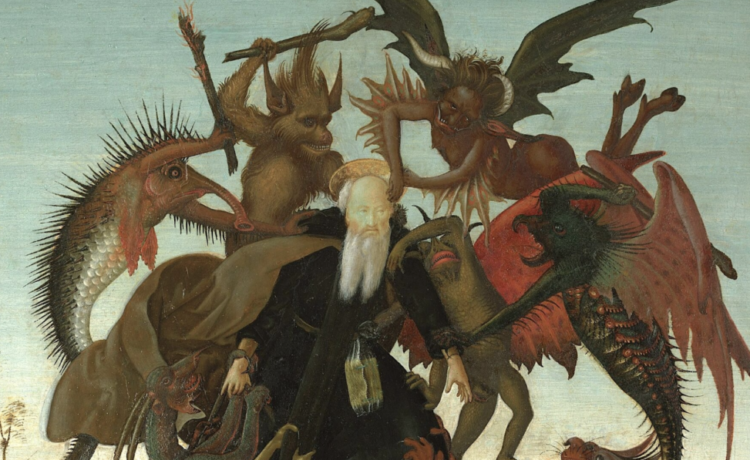
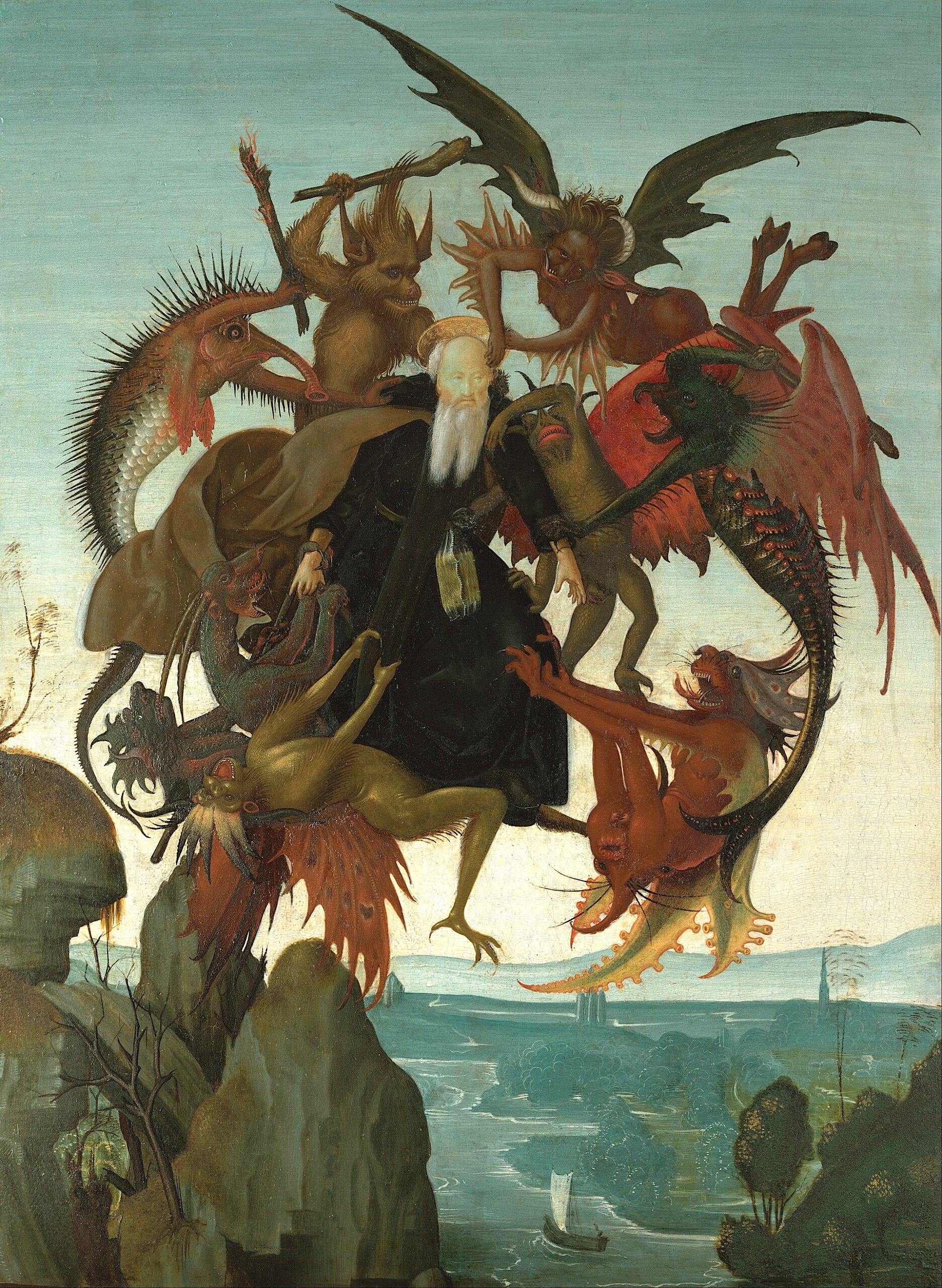
Think back, if you will, to the works of art you created at age twelve or thirteen. For many, perhaps most of us, our output at that stage of adolescence amounted to directionless doodles, chaotic comics, and a few unsteady-at-best school projects. But then, most of us didn’t grow up to be Michelangelo. In the late fourteen-eighties, when that towering Renaissance artist was still what we would now call a “tween,” he painted The Torment of Saint Anthony, a depiction of the titular religious figure beset by demons in the desert. Though based on a widely known engraving, it nevertheless shows evidence of rapidly advancing technique, inspiration, and even creativity — especially when placed under the infrared scanner.
For about half a millennium, The Torment of Saint Anthony wasn’t thought to have been painted by Michelangelo. As explained in the video from Inspiraggio just below, when the painting sold at Sotheby’s in 2008, the buyer took it to the Metropolitan Museum of Art for examination and cleaning.
“Beneath the layers of dirt accumulated over the centuries,” says the narrator, “a very particular color palette appeared. “The tones, the blends, the way the human figure was treated: all of it began to resemble the style Michelangelo would use years later in none other than the Sistine Chapel.” Infrared reflectography subsequently turned up pentimenti, or correction marks, a common indication that “a painting is not a copy, but an original work created with artistic freedom.”
It was the Kimbell Art Museum in Fort Worth, Texas that first bet big on the provenance of The Torment of Saint Anthony. Its newly hired director purchased the painting after turning up “not a single convincing argument against the attribution.” Thus acquired, it became “the only painting by Michelangelo located anywhere in the Americas, and also just one of four easel paintings attributed to him throughout his entire career,” during most of which he disparaged oil painting itself. About a decade later, and after further analysis, the art historian Giorgio Bonsanti put his considerable authority behind a definitive confirmation that it is indeed the work of the young Michelangelo. There remain doubters, of course, and even the notoriously uncompromising artist himself may have considered it an immature work unworthy of his name. But who else could have created an immature work like it?
Related Content:
How Four Masters — Michelangelo, Donatello, Verrocchio & Bernini — Sculpted David
A Secret Room with Drawings Attributed to Michelangelo Opens to Visitors in Florence
Michelangelo’s Illustrated Grocery List
Based in Seoul, Colin Marshall writes and broadcasts on cities, language, and culture. He’s the author of the newsletter Books on Cities as well as the books 한국 요약 금지 (No Summarizing Korea) and Korean Newtro. Follow him on the social network formerly known as Twitter at @colinmarshall.