
By Karen Cresap, President of the Cresap Society and President of the Michael Cresap Museum, Inc.

Hannah Johnson Cresap was born in Maryland during the 18th century, and her life story is one that still provides endless inspiration. As the matriarch of a frontier family, Hannah’s legacy is one of strong leadership qualities during stressful times along with a fierce resilience. As her eighth-generation great-granddaughter, I share her story only through history – I doubt Hannah could have imagined that three centuries later, she is thought of daily.
Hannah was one of several children born to Daniel and Frances Kilbourne Johnson on June 2, 1705, on the Johnson family land of “Eightrupp” in Lapidum in the Havre de Grace area of Harford County. There she met a young carpenter from England named Thomas Cresap who had likely found his way to “Eightrupp” for work. Cresap would later become a well-known frontiersman and land speculator, remembered today for his role in the violent dispute over the boundary between Maryland and Pennsylvania. They married in Baltimore on April 30, 1727, beginning a life of trials, trails, forts, and fire, with a couple of Cresap Wars thrown in.
At their first settlement, near today’s Wrightsville, Pennsylvania – then claimed by Maryland – Hannah led a militia group along the river on search parties during the Maryland-Pennsylvania border dispute while Thomas ran his Blue Rock Ferry across the Susquehanna River. She reportedly carried her own rifle and bugle to alert those across the river of any unwelcome intruders.
It was on this riverbank that a Pennsylvania Sheriff arrived with an arrest warrant for Thomas and set the Cresap cabin on fire with the family inside. Thomas fled in one direction to allow his wife and children to escape alive in the other, but he was captured and imprisoned in a Philadelphia jail. After Hannah was left wondering for two years if Thomas would ever return, he was finally released and the family moved westward.
The next Cresap adventure evolved on “Long Meadow” in Williamsport, where Thomas and Hannah lived the life of fur traders, exporting skins and furs to Europe until the French stole a cargo ship carrying a load of the Cresaps’ furs in the hold – and with it, all their proceeds. Thomas sold the family’s “Long Meadow” home to pay a 500-pound debt to Daniel Dulany and the Cresaps would move further west one last time.

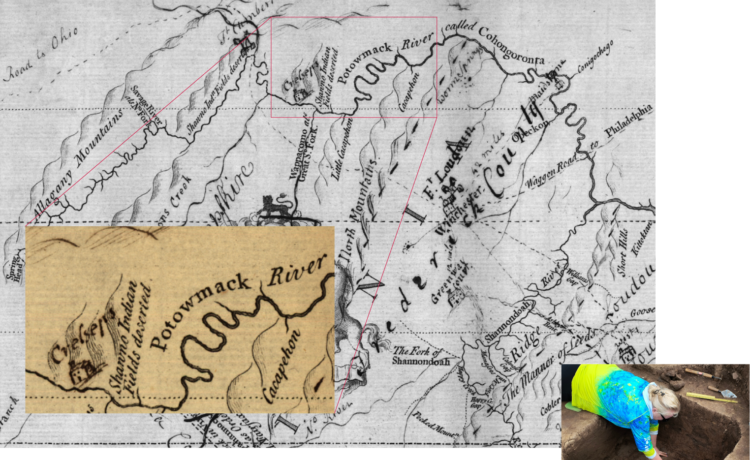
Thomas purchased land in Western Maryland they named Skipton (after his birthplace in England), settling near a former Pekowi Shawnee village. Though this town had been deserted, the name given to it by Shawnee King Opessa – “Shawnee Old Town” – would stick instead. Made of stone and nestled up against the Potomac River, the largest of the Cresap homesteads would become legend.

During the 2024 Tyler Bastian Field Session in Maryland Archaeology, one of the artifacts discovered on this land was a large piece of what is thought to be a gravy or sauce boat made from white salt-glazed stoneware dating from 1720-1770. Given the dates, and the Cresap landowner, the gravy boat may have been part of Hannah Cresap’s tableware collection. As her descendant, to hold something so precious in my hands, that Hannah had also likely held in her hands, was a life-changing experience. Archaeologists also found a good amount of Chinese export porcelain dated to 1690-1797 with pretty trellis-in-blue markings, which means Hannah set a more sophisticated table on the wild frontier than most would expect.
I like to imagine what Hannah Cresap would serve with the gravy in her gravy boat. Yorkshire pudding – a flour-based baked popover that is served with roast beef – of course! A thick gravy is an important part of this famous and centuries-old custom that I believe would have been a favorite of Thomas Cresap’s given his homeland in Skipton, the Gateway to the Yorkshire Dales. Perhaps Hannah served this dish at Thomas’ request when a young George Washington came for dinner and stayed several days at Cresap Fort in 1748. Perhaps they used the trellis-in-blue porcelain when they dined?
Hannah did not live to see her youngest son, Michael, lead the First Company of Maryland Riflemen in 1775. We presume that she died in Oldtown at her beloved Cresap Fort around 1774, however, how Hannah’s story ends still needs to be discovered. I often wonder what she might have thought had she lived longer – a new country on the horizon and her youngest child chosen as a Captain at the start of the Revolutionary War to bring troops to support General George Washington.
Being the wife of Colonel Thomas Cresap probably came with some challenges. Thomas was fierce in his convictions, determined and likely pretty bullheaded at times. When he traveled to Virginia and signed a land lease with the Washington family and returned home to announce they were moving to Virginia, it was Hannah who declared to Thomas that they were staying in Maryland. In a time when women did not usually have a voice, I imagine the moments when Hannah’s voice was heard, her responses to the challenges of the time kept her family safe and on track.
On the long 500+ mile Beeline March leading Cresap’s Rifles from Oldtown to Cambridge, Massachusetts, with endless days of intense heat while also suffering from a fever, Captain Michael Cresap must have been aware there was a chance that he might not survive this expedition. His mother had recently passed, leaving a great absence, and I think at a time like that he would have thought of her. It would have taken not just a strong father, but also a strong mother, to raise a son who could both survive in the great wilderness and have the leadership qualities needed to successfully lead a Rifle Company towards their emerging new country.

As we celebrate the 250th birthday of America’s Independence, the Michael Cresap Museum welcomes all who wish to walk in the footsteps of a legendary frontier family. Captain Michael Cresap’s c.1764 built stone house is listed on the National Register of Historic Places and continues to keep watch from a hill on Opessa Street in Oldtown (Allegany County). In this stone house, not only did the Captain prepare Cresap’s Rifles to support George Washington, but on a simpler and more personal level, this is where Hannah would have taught her granddaughters how to make that Yorkshire pudding and how to set a proper table.
The 110-year-old Cresap Society, comprised of Hannah’s descendants worldwide, preserves her stories and celebrates her family’s heritage. All who continue to live by the principles and life lessons that Hannah Cresap gave us, are grateful for the strong women of the 18th century who showed us how important it is for women’s voices to be heard. On our Semiquincentennial, let us remember the women who helped create this nation and may we always celebrate their contributions.
References:
Bailey, Kenneth P., 1912-2000. Thomas Cresap, Maryland Frontiersman. Boston, Mass.: The Christopher publishing house, 1944.
Cresap, Joseph Ord,. The history of the Cresaps. McComb, Miss.: Cresap Society, 1937.
Jacob, J. J. 1758?-1839. (1866). A biographical sketch of the life of the late Captain Michael Cresap. Cincinnati, O.: Re-printed from the Cumberland ed. of 1826.
Washington, George. “[Diary entry: 21 March 1748].” Founders Online, National Archives. https://founders.archives.gov/documents/Washington/01-01-02-0001-0002-0010.
Discover more from Our History, Our Heritage
Subscribe to get the latest posts sent to your email.