

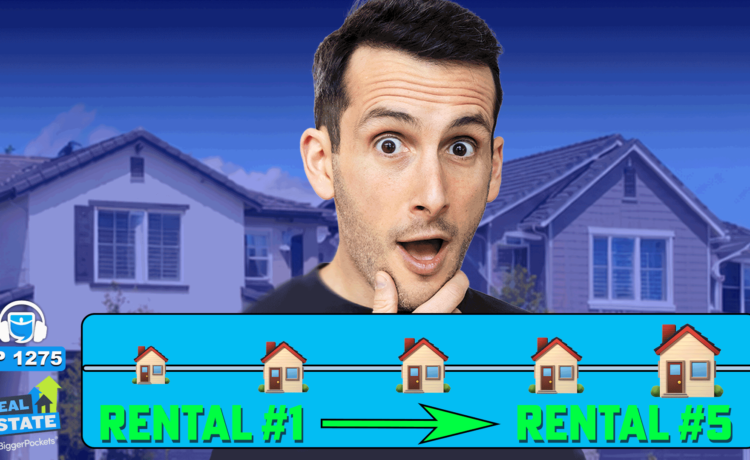
5 paid-off rentals vs. 15 rentals with mortgages. We get this question a lot: Should I pay off my rental properties or use the cash flow to keep scaling? Many investors believe you need a dozen or more rentals to become financially free. So, in today’s show, we’re going to show you the overlooked math behind having five paid-off rental properties, and whether it’s worth it to keep scaling to over a dozen doors.
I’ve modeled out both scenarios (pay off rentals vs. buy more) to see which gets you to financial freedom faster, which leaves you with a bigger net worth, and which pumps out more cash flow so you can do what you want with your time. We’re using real, inflation-adjusted numbers: $400K home prices, $250/month cash flow, 30-year loans. These are the types of deals we’re buying even in 2026.
So which scenario would Dave pick? Dave has a clear answer on the option he thinks is best for most real estate investors, and what to do if you pay off your rental properties but want to scale slowly when the right deal arrives.
If you’ve got some cash burning a hole in your pocket, this is the episode to hear before you make a move.
Dave Meyer:
Would you rather have 15 leverage properties or just f, but those five are fully paid off. This is always the debate among investors. Do you want scale or do you want simplicity? Which one ultimately builds more net worth and which one helps you replace your income the fastest? If you want to find 15 good deals to scale, it is still very possible, but it’s going to take some work. So you should at least know if it’s worth it financially to put in that work. When do you keep scaling up and when do you start paying down? Today I’m showing you the full math. What happens if you just buy five properties and sit on them, paying down your mortgage and increasing your equity over time? And what happens if you go in the other direction and continue investing your cashflow into additional units? The results may actually surprise you.
What’s up everyone? I’m Dave Meyer, Chief Investment Officer at BiggerPockets. Today we’re tackling a question I get asked all the time. Should I keep scaling or is it time to take your foot off the gas? And I’ve actually done the math to answer this question and to show you what happens to your cashflow and your net worth in different scenarios. I’ve got a whole bunch of charts to show you to explain who should keep accumulating more properties and who should start paying down their debt. Let’s get right into it. So for our conversation today, we have to assume that you get to five properties, right? I had to create a scenario and the one that we’re doing is you start with five properties and decide, do you take the money from those five units, the cashflow that you’re generating and the equity and use it to scale or use it to pay down the debt on those five properties.
Now in this video, we’re not going to get into how to get to those five units. We’ve done lots of other videos and episodes on how to do this. In today’s episode, we’re going to talk about what happens from there because once you get to roughly five units, that’s where the magic really kind of starts to happen. But the questions also come too because you have these assets, you have money and capital under your control. What do you do with it at that point? Do you keep scaling or do you pay off debt? And this is a super important question because I imagine if you got five units, you’re cash flowing hopefully a couple hundred bucks a month, which is great, but it can also feel kind of intimidating to do the math in your head and think, “I need to get to 20 or 30 units to actually replace my income.” And although that’s absolutely possible, is it worth the effort?
So I created a scenario to just show you how this works over time. The exact numbers will of course change a little bit for each person, but hopefully this will give you the gist of whether you want to scale or whether you want to pay down your debt. The example I’m using, I’m going to assume those five properties were bought for $400,000 each close to the national average right now and you did that over the course of about 10 years. Other assumptions is you’re doing cashflow the right way. You’re taking account all of your expenses, you’re hiring a property manager, you’re getting 3,400 bucks in rent and when you do all the math that nets you 250 bucks per month in cashflow for each of the five properties. So you’re getting 1,250 all told from your portfolio that you’ve built over the last 10 years.
These are examples. These are realistic numbers. These are kind of deals that you can get today. This is nothing special, but this is a solid portfolio of five properties. Let’s talk about the scaling option first and how you could scale up from here. The way you do that is you take 100% of your cashflow from existing properties and use it to save for the next property. You’re taking 1,250 a month from your cashflow putting that to the side. I’m going to also assume because you’re a good budgeter and you’re able to get to five properties in the first place, you have some excess income that you can contribute to your next property as well. And I just put that at 1,250 a month in additional capital as well. And so all told, you’re accumulating $2,500 a month to put towards your next deal. I’m also going to assume that you buy more 400,000- ish properties.
So the way I’m going to model this out is that as soon as you save up $100,000 for a down payment, because investors typically have to put 25% down, you go and buy a new deal. It’s as simple as that. So what happens in this scenario if you just do that for the next 30 years, what happens? Well, big picture stuff, you would acquire approximately 10 more properties for a total of 15 properties and at the end of 30 years, your cash flow is approximately $99,000 in tax advantage cashflow. That is pretty darn good. And the equity side is even better. It is massive. Your estimated equity position in this simple scenario would be about $6.6 million. That is absolutely massive. This is the benefit of buying real estate with leverage and holding onto it. You accumulate a lot of net worth over the 40 years you have a portfolio in this scenario.
So to prove this out, I actually built a financial model in Excel. It’s a little bit complicated, but if you’re watching on YouTube, I’ll just quickly show you how this works. So you’re starting with $875,000 of equity from those first five deals. Then you have annual cash flow from your properties of $15,000 a year. That’s where you’re starting position. I did model for that to go up at 2% per year so your cashflow is growing. I kept the contribution that you’re putting in from your own lifestyle at 15,000. And so you can see here that about every three years or so, your down payment savings accumulates up to about $100,000 and at that point you acquire a new property. When you do that, you get an additional $100,000 in equity in your down payment, but you also accumulate $300,000 of more debt. And so that will alter your cashflow and income.
But if you just keep doing that over the course of 30 years, you will buy properties roughly every two to three years and you’ll wind up with 15 properties at the end. And the estimated equity value of that, growing at roughly 3% a year, that’s the average appreciation, long run appreciation in the US average is a litle bit over 3%, but I put it at 3%. And if you keep doing that, your estimated equity position is going to be $6.6 million. That is absolutely incredible. But the trade off here, there are trade offs, you’re going to get that massive equity boost, but the trade off here is cashflow because as you can see in this model, or I’ll just explain it to anyone listening, your annual cashflow does go up from $15,000 in year one to almost $70,000 in year 25, for example, but you’re not using that.
You’re not actually taking that and putting it towards your lifestyle at that point. You’re reinvesting it back into your deals, which can be totally worth it for you if you want to scale, but that’s an important trade off that you need to consider. In this scenario, you are not going to touch that income until year 30, at which point you will have nearly $100,000. It’s actually 99,000, nearly $100,000 though in tax advantaged cashflow. Now, I should point out that I had to come up with an example. I made it 30 years. If you wanted to scale for 25 and then take your cashflow, you could do that too, but I just picked 30 years. That’s a traditional length that you might want to invest for. So I’m using that, but you can obviously adjust this a little bit based on your own scenario. So this is scenario one, which is scale up.
So that was scenario one, which is scaling up to 15 properties. We got to take a quick break and then after that, I’ll show you the same math for scenario two, which is reaching five properties and paying them off over time.
Welcome back to the BiggerPockets Podcast. Before the break, I showed you an example of cashflow and net worth for a portfolio of 15 properties, but what about paying down your mortgages on just five properties instead? What about paying down your mortgage instead? In this scenario, rather than using your cash flow of $1,250 a month to save up, you use it to pay down your mortgages. Same with the 1,250 in disposable income you use. So those assumptions don’t change from one scenario to another. You still have $2,500 a month to do something with in your portfolio. But in this scenario, every month you use that 2,500 bucks just to pay down mortgages as aggressively as possible. So what happens here according to our model? Well, you stay at only five properties, right? The whole point of this model is not to scale. You’re going to stay at five properties.
It’s not as sexy as the scale-up scenario, right? You won’t have as much door count to brag about and your equity will be lower. At the end of 30 years, if you look at the model here, if you’re watching on YouTube, or I’ll describe it to you, starts at the same 850,000 in equity and gets you over 30 years to $4.36 million. Still incredible, right? That’s still a massive net worth, but it is lower than the $6.6 million in the other scenario a lot lower. It’s $2.3 million lower, so that is a considerable trade-off. But just like the first scenario was strong in net worth and weaker in cash flow, the paydown scenario is worse in net worth and equity, but is much stronger in cashflow. According to my example, if you look at this here, it would take you 17 years to be 100% debt free.
Just taking that 2,500 bucks a month and paying it down, that debt that you had at the beginning and day one, it never gets bigger. You’re not going out and buying more property so your debt stays fixed and you just keep paying it down and down and down and it will take you about 17 years to get 100% debt free. At that point, at 17 years in, you would be earning $135,000 in tax advantage cashflow. So that’s 35% more cashflow and you’re getting that cashflow 13 years earlier. That’s pretty darn good, right? You could own just five rental properties, meaning les work, less responsibilities, and you could live off your debt-free cashflow after just 17 years. Now again, you’re going to take a hit on overall equity, but it is a lower risk approach. It’s higher cashflow and it gets you to financial freedom a whole lot sooner under the presumption that you could live off $135,000 in tax advantage cashflow.
So which is the right answer, right? We have two good scenarios. Like I said at the beginning, you get to that five properties, all your options are pretty good. You could scale up, get higher equity and net worth at expensive cash flow, or you could pay down get better cashflow at the expense of net worth. So let’s just go through the numbers again. With scale up, you get a higher net worth and total equity. You end 30 years at 100K in cashflow and $3 million in remaining debt. That is an important thing at scale up. Even if you stop scaling, you still have debt, which your properties will probably be able to cover. That shouldn’t be a problem to you at that point, but you still will have some debt. So you’re not going to see that big uptick in cashflow that you get when you’re totally debt free and you’re no longer paying mortgages on any of your properties.
That will come eventually, but it could come 60, 70 years from now, right? If you’re taking a 30-year mortgage 30 years from now, you’re not making that last payment until 60 years from now. So that is something to keep in mind. With the paydown, your equity is $2.3 million lower after 30 years, big trade-off, but you can be financially free 13 years sooner and you’d have almost 40% more cashflow per month even when the scale-up person retires. So which do I choose? Personally, the choice is pretty clear here. For me, I choose paydown and here’s why. I am in real estate. I got into real estate in the first place because I want freedom over my time. I want simplicity in my life and having a portfolio with $0 in debt and cashflow I can live off much sooner in my life and honestly a smaller portfolio with fewer maintenance problems and projects sounds more like the financial freedom that I have been in this for to me.
That is what I’ve been striving for and that’s what I actually want. Of course, to each their own. Different people want different things, but for me, it’s even worth giving up that potential $2.3 million in extra equity to have 12 years of my life when I’m not grinding and I have all that debt-free tax advantage cash flow. And plus, my equity is still worth more than $4 million in this scenario. And for me, that’s enough. That is personally what I’m going to pursue. But of course this is just an example. I spent actually realistically much more of my career in quote unquote growth mode. I probably spent 10, 11 years acquiring properties before I switched into this mode of being more passive and starting to focus on having less debt and higher cashflow in my properties. For me, that’s because I started relatively early. I started when I was 22 years old and so I wasn’t as focused on getting that debt-free tax advantage cashflow that soon.
Once I hit like 32, 33, I started thinking, if it’s going to take me 17 years to pay this down at 50, it sounds pretty good to be debt free and have all of that cash flow. So that’s sort of when I made that shift. And honestly, the example that I’ve shown you today is one example. Obviously there are a million variables. You can change the number of years here, the purchase price of properties, how much your cashflow, all of that, but the mindset is the same. So the example I gave you is the extremes of both scenarios. On one end, you’re just taking every dollar you got and you are paying down your debt as aggressively as possible. On the other extreme, you are scaling at all costs. You’re not taking any of that cashflow for yourself. And I did this on purpose. I picked this scenario to show you the extremes because I wanted to demonstrate the trade-offs that exist between cashflow and net worth based on the strategy that you pursue.
All right, I got more for you on this debate, but we do have to take a quick break. We’ll be right back Welcome back to the BiggerPockets podcast. Let’s get back into our conversation about what’s better, five paid off rentals or 15 properties with debt. I actually believe that for me, there will be a day where I stop acquiring properties and I do just pay down my debt.That’s the only thing that I’m going to do, but that’s not where I’m at personally. I’m no longer in growth mode where I’m just maximizing my leverage and just buying as much as possible. I’m more in the middle. And I do think that there is sort of this transitionary stage that most investors go into. When you’ve reached a good size portfolio, but you’re not ready to say, “I’m not buying any more deals.” Just for me, example, I’m 38 years old.
I have been very fortunate in my real estate investing career. I have built a very strong portfolio and I don’t necessarily need to keep growing, but I’m not going to completely stop. I am choosing instead to just be much more opportunistic in my approach to real estate. I’m not going to buy every two years just because I have to. I might buy more rapidly than that, but I’m just only going to pick deals when they are really, really highly aligned with my strategy. And for me, that’s a great place to be. You can be very picky, you can be very patient and just pick the best deals. And what I’m going to do when I buy those deals is try to hedge a little bit. Rather than putting just 25% down and putting them on 30 year fixed rate mortgages, I’m going to take this idea of deleveraging and paying down my debt even into my next acquisition.
Now, I know that might seem confusing, but there are actually two really good proven ways that you can do this. The first is just by putting more money down. Now, I know when you’re in growth mode, that might seem crazy because that means you are buying less properties. But for me, at this point in my sort of harvest stage of my career, I could say, “You know what? I really like this property. It’s in a great location. It’s a great asset. I want to own it for a long time, but I don’t want to maximize my leverage. I’m not trying to add that much more debt to my overall portfolio. So what I’m going to do is I’m going to put 30% down. I’m going to put 40% down. I’d even put 50% down. There are properties actually in the last few years I’ve just bought with cash because they were affordable and I thought that’s just a great way to deleverage my overall portfolio is to never put a mortgage on this property.
So that’s one approach that you can do to sort of hedge these two different extremes. One of the other options you can do is to use a shorter term mortgage. Most people use a 30-year fixed rate mortgage, but you could use a 15-year mortgage, which has a couple of benefits. First and foremost, 15-year mortgages typically have a lower interest rate than a 30-year fixed. They can be 75 basis points, so 0.75% lower than a 30-year fixed rate mortgage. Sometimes it varies, but that’s an average, so that’s pretty good. And on top of that, the total amount of interest that you pay the bank over the lifetime of your loan is much, much lower. So those are really good benefits. Of course though, if you’re paying down the same amount of debt in half the time, your payments are going to be a lot higher. So that’s the trade-off is that you will have higher monthly payments.
So one thing I am considering doing, I haven’t done this yet, but I’m actually looking at underwriting deals this way right now is can I use a 15-year mortgage and put more money down to make sure it cash flows right now, still cash flows five, six, 7%, which is good enough. And then in 15 years, because I would only do this on an excellent asset, now I’m going to own this excellent asset free and clear in half the time that I would if I put it on a 30-year mortgage. That’s just one of the adjustments I’m considering making a little bit later in my investing career. And it’s one way that you can sort of hedge between the two extremes in the example that I showed you before. I will mention that it’s not just me. This is a very common approach that I see with successful real estate investors.
Don’t get me wrong, if you want to be a tycoon, if you want to get a lot of units, go for it. Keep growing. But if financial freedom and freedom over your time and low risk, low headaches, if that is your goal, once you’ve grown to a solid size, which will depend on the person, I used five in this example, but that could be five, it could be eight, it could be 10, right? It’s going to depend. Once you get to that level where you’re like, ” I’ve actually built something here. I have control over assets. I have equity. I have real cashflow that I can choose either to live off to pay down my debt or to keep scaling. “Once you get to that point, take stock of what you have and consider at least the approach to deleveraging. It could just get you to the life you’ve been striving for decades sooner than scaling just because people on social media like to brag about their door count.
The whole key with this, like everything in real estate is to know what you’re aiming for, to know what your goal is. If your goal is financial freedom faster, then I would recommend giving a good, hard look at paying down your debt and de- leveraging your portfolio over time. If you want to scale and maximize your net worth and equity over time, keep buying, keep growing. But whatever you do, make sure that your strategy is aligned with your personal goals. That’s our episode for today. Thank you so much for watching this episode of the BiggerPockets Podcast. I’m Dave Meyer. See you next time.
Help us reach new listeners on iTunes by leaving us a rating and review! It takes just 30 seconds and instructions can be found here. Thanks! We really appreciate it!
Interested in learning more about today’s sponsors or becoming a BiggerPockets partner yourself? Email [email protected].