
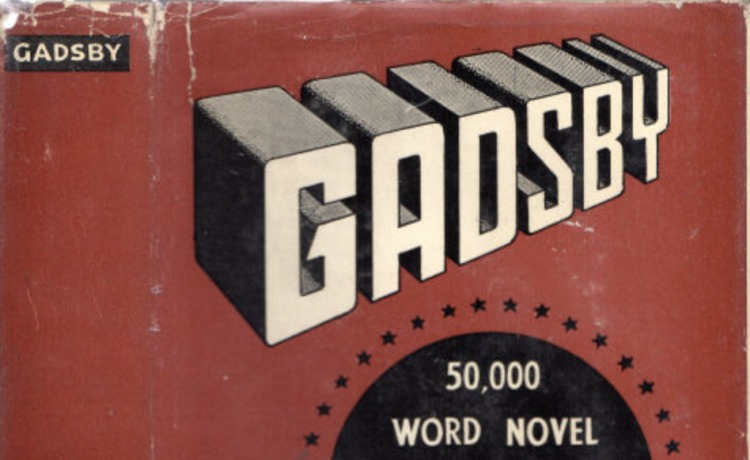
“If Youth, throughout all history, had had a champion to stand up for it; to show a doubting world that a child can think; and, possibly, do it practically; you wouldn’t constantly run across folks today who claim that ‘a child don’t know anything.’ ” Ranked alongside the other notable opening sentences of American literature, this falls somewhat short of, say, “Call me Ishmael.” The entire novel that follows is written in the same oddly stilted, circumlocutive prose, and a reader who skips the author’s introduction may not perceive just what has set it askew for some time. They’d also have to be reading an edition other than the first, with its bold promise of a “50,000 WORD NOVEL WITHOUT THE LETTER ‘E.’ ”
The book is Ernest Vincent Wright’s Gadsby (1939). Though self-published in the late nineteen-thirties to no fanfare, it’s now acknowledged more or less widely as a literary oddity, far more often cited as a piece of trivia than actually read. (I first learned of it from a list of fun facts on the back of a cereal box, which, looking back now, seems culturally appropriate.) As the Disambi video above explains, in denying himself e, the single most common letter in the English language, Wright denied himself the, as well as “the majority of pronouns, like he, she, they, them, theirs,” and so on. “Past-tense words that use –ed are out of the question, as is any number between six and thirty.”
To some, more surprising than the fact that Wright managed to compose a full-length novel this way (overlooking three thes and an officer that slipped into the initial print run) is the nature of the story he channeled this considerable effort into telling. John Gadsby — not to be confused with the similarly named, much more famous title character of another novel from the previous decade — returns in middle age to his hometown of Branton Hills, which has slid into a state of advanced dissolution. In despair, he assembles a youth league dedicated to breathing life back into the place, and before those 50,000 very nearly e‑less words have passed, the population has grown thirtyfold, and he’s become the mayor.
In truth, American literature of the early twentieth century is littered with Gadsbys; it’s just that none of the authors of those forgotten homilies on civic-minded boosterism thought to use so striking a gimmick. Technically called a lipogram, the technique of omitting a particular letter has since been used since to greater literary effect. With their characteristic weakness for American eccentricity, certain French intellectuals eventually took up Gadsby as a kind of model. In 1969, Georges Perec published the longer but similarly e‑less La Disparition, which would have been much more challenging to write, given the French language’s even greater reliance on that missing vowel. Far from a parlor trick, its lipogram resonates with both the content of the story and sense of absence felt by the author, who’d lost both parents in World War II. As for this post, perhaps you’ve noticed that it’s been written thus far without a single instance of the letter z. Please clap.
Related Content:
How to Jumpstart Your Creative Process with William S. Burroughs’ Cut-Up Technique
An Introduction to the Codex Seraphinianus, the Strangest Book Ever Published
American Literature, From the Beginnings to the Civil War: A Free Online Course from NYU
Based in Seoul, Colin Marshall writes and broadcasts on cities, language, and culture. He’s the author of the newsletter Books on Cities as well as the books 한국 요약 금지 (No Summarizing Korea) and Korean Newtro. Follow him on the social network formerly known as Twitter at @colinmarshall.