
With his last picture The Fabelmans, Steven Spielberg told a story of his own. Given his long-held stature as more or less the personification of big-screen Hollywood entertainment, there’s only one such story he could have told: that of how he became a filmmaker. The most memorable of The Fabelmans depicts the young directorial surrogate alone in the basement of his family home, re-creating the train crash scene from The Greatest Show on Earth with an eight-millimeter camera and a Lionel set. Today, on the brink of his ninth decade with his famous productivity hardly slowing, Spielberg remains, on some level, the wide-eyed boy smashing his toys together at just the right angle. What better way to pay him tribute than to replicate his cinematic achievements in miniature?
The Fabelmans ends with its protagonist a college student, eager to drop out and go straight to Hollywood. At the same point in life, the real Spielberg was about to receive an offer from Universal Pictures to write and direct the short film that became Amblin’, which itself led to a contract to direct television productions.
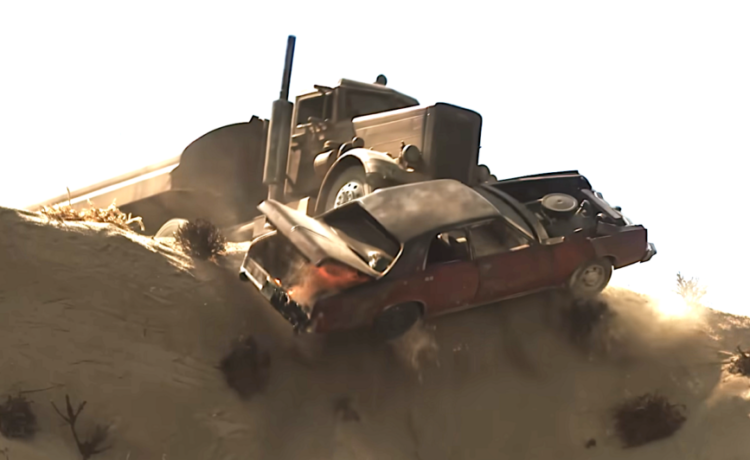
He showed what he could do with episodes of Marcus Welby, M.D., The Name of the Game, and Columbo, among other series. Then he stepped up to TV movies, a form regarded as inferior in all respects to theatrical releases, but one he managed to transcend on the first try. When it first aired in 1971 as an ABC Movie of the Week, Duel presented its viewers with a harrowing, near-mythological confrontation between a middle-aged traveling salesman in a Plymouth Valiant and an unseen trucker in a hulking, smoke-belching big rig who seems bent on destroying him.
Given that its director was just 24 years old at the time, Duel very much counts as early Spielberg. Yet it’s also distilled Spielberg, a head-on treatment of middle-class normality’s sudden encounter with a force of incomprehensible menace — a theme much revisited in his work since — with cinematic rhythms precisely calculated for optimal tension and release. An aspiring filmmaker could learn much from re-creating its sequences shot-for-shot. The YouTube channel Movies Miniatures Effects does just that in the video above, which documents a remaking with 3D-printed maquettes of the final crash, after Dennis Weaver’s desperate everyman manages to outwit his pursuer. “Sheer skill needed more philosophy for a fitting resolution,” wrote David Thomson of this ending. Perhaps so, but the more than 18 million views so far racked up by its miniature version do suggest a film that more than retains its power after 45 years.
Related Content:
Watch Steven Spielberg’s Rarely Seen 1968 Film Amblin’
Watch Steven Spielberg’s Debut: Two Films He Directed as a Teenager
How Movies Created Their Special Effects Before CGI: Metropolis, 2001: A Space Odyssey & More
How Car Chase Scenes Have Evolved Over 100 Years
Based in Seoul, Colin Marshall writes and broadcasts on cities, language, and culture. He’s the author of the newsletter Books on Cities as well as the books 한국 요약 금지 (No Summarizing Korea) and Korean Newtro. Follow him on the social network formerly known as Twitter at @colinmarshall.