

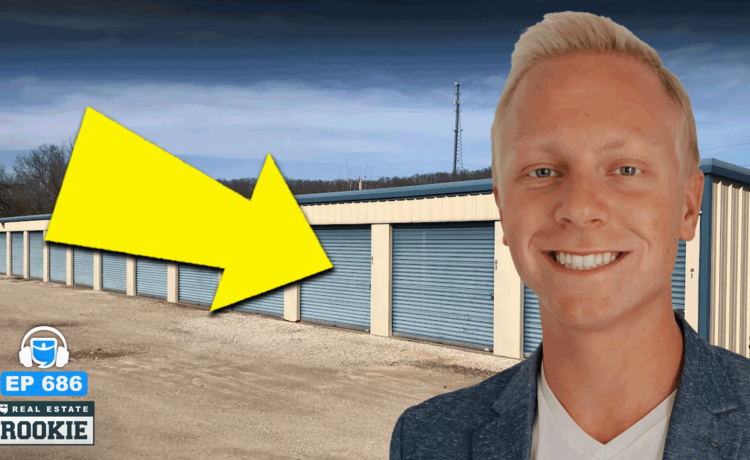
Think building a portfolio or “retiring” with real estate is too far out of reach? Just eight years ago, today’s guest was graduating from college and starting a full-time job. Now, he makes six-figure cash flow and has ditched his W-2 job before the age of 30—all thanks to an investing strategy that allows you to build wealth without tenants or toilets: self-storage.
Welcome back to the Real Estate Rookie podcast! At just 23 years old, Steven May did what so many rookies are afraid to do: He bought a house, rented out the rooms, and used his cash flow to help buy the next one. But then, he discovered self-storage investing and everything changed. His first facility was the kind of deal most investors only dream of—one he purchased for roughly the same price as a single-family home that cash flows over $3,500 a month!
But pivoting from residential to commercial real estate wasn’t easy. Steven had to learn a new asset class, where to find deals, and how to get enough capital to scale his real estate portfolio. But in this episode, he’ll show you each step he took to go from buying simple, single-family house hacks to multimillion-dollar self-storage facilities!
Ashley:
Today’s guest went from working full-time as a registered nurse to building a self-storage portfolio of multiple facilities before turning 30. And he didn’t do it with a syndication or huge investors. He started with a cold call, a 15% down bank loan, and a willingness to learn a completely new asset class from scratch.
Tony:
And what I love about his story is that this wasn’t some overnight viral success. He was house hacking, buying single family rentals, and then made a strategic pivot into self-storage. And once he figured out that model, he started buying another facility and another one in roughly every six months. And today we’re breaking down exactly how he did it.
Ashley:
This is The Real Estate Rookie Podcast. I’m Ashley Kehr.
Tony:
And I’m Tony J. Robinson. It’s give a big warm welcome to Steven May. Steven, thank you for joining us on The Ricky Podcast today.
Steven:
Hey, thanks for having me on. Excited to chat today.
Ashley:
So after college, you started investing by house hacking, and then you started buying single family rentals while working full-time, and you were a registered nurse. But things change in 2021. You pivoted into self-storage. So this is an asset class that you never operated before. So what made you decide to switch from investing in single family rentals to into self-storage?
Steven:
Yeah, I wish I could nail down just an exact moment where I had a light bulb moment of going into storage was the future of what my portfolio would hold. But yeah, I was in nursing school, learned a lot from BiggerPockets, was listening to the podcast, reading the books, started with a house hack, bought another house hack. Waited about a year. I thought I was just really going to go into small multifamily. That was the plan. Just saving up cash, thought I would go put 25% down. And once again, I don’t know exactly what triggered me to get into storage. I think just slowly by hearing about the asset class from people like AJ Osborne, who’s active with BiggerPockets, listening to his podcast, reading his book, driving on the highways, seeing these storage facilities, and it just kind of being in the back of my mind of this asset class on paper seems simple.
You’re renting out metal boxes. You hear the no tenants, no toilets, and that whole spiel about it. So yeah, the pivot from residential to commercials played out well for us.
Tony:
Was there something that frustrated you, Steven, about the single family space that kind of made this move more attractive or was it more so just a natural progression?
Steven:
Yeah, I think a little bit of both. I mean, single family investing is great. I would still buy single families that the right deal pops up. I mean, my full-time job is I’m a realtor selling single-family homes to a lot of out- of-state investors, so I totally get it. It can be a great business model. I think with the storage, it was kind of the same concept of I was thinking about going into multifamily. It’s commercial real estate where there’s a little bit more of economies of scale. A hundred-unit facility was our first one, so just being able to have some vacancy there, but still cover your mortgage with quite a bit of cashflow leftover as well. And ultimately, yes, I mean, I’m not going to call it passive by any means. I don’t think anything’s truly passive, but in general, just a little bit less maintenance quote unquote compared to the single family world of we don’t really have windows, we don’t have that many appliances, we don’t have toilets.
So that was kind of a big point into getting into that asset.
Ashley:
What did your single family portfolio look like at this time?
Steven:
Yeah, so I bought my very first one at 23. I actually bought it a couple of weeks before graduation. So I was literally in nursing school studying for my state boards test while also reading BiggerPockets books, listening to the podcast in between. And so I moved to a new city, Kansas City. I’m from St. Louis, so still Missouri. But basically, yeah, went to Kansas City one weekend, toured a couple houses, had been studying the house hacking method. So went and got a 3% down conventional loan. So that’s what I started with. House hacked, rented out the rooms to a couple buddies. Eight months later, bought another one. So within a year, basically bought two single family homes, got the real estate bug for sure. Knew I was going to keep buying some sort of real estate. I thought the plan was single family, multifamily. So just kept looking, studying, seeing how to scale efficiently, but while working, still full-time as a nurse.
And so before I got into the storage asset class, I mean, it was 2019, I had two single family homes. Looking back, 2020, I did not buy anything. Unfortunately, looking back, I wish I would’ve because it was a great real estate market and environment with rates and inventory. And then 2021, ended up buying two more single family homes. And at the end of 2021 was when we took down that first storage facility. Haven’t bought a single family home rental since. And basically we’ve purchased eight storage facilities since, and we currently hold seven of them.
Ashley:
Congratulations.
Tony:
Yeah, incredible journey. And I’m excited to get into your story here. But for the rookies who have only heard of houses and apartments, and that’s all they think about when they think about real estate investing, what made you think specifically that self-storage is actually a bigger and better opportunity?
Steven:
Yeah, you kind of don’t know what you don’t know when you’re starting. I mean, once again, reading the books, listening to the podcast on paper, it seemed like an ideal asset class. Wanting to get into storage, it’s definitely not your standard single family home investing. You can’t just go on Zillow and there’s a handful of single family homes available to purchase and look at rental comps. Storage is definitely less inventory available. A lot of times, I mean, especially in 2019, 2020, it wasn’t as sexy of an asset class. It’s definitely become pretty hot. In the last few years, a lot of people trying to get into it. And so in that regard, I mean, you really had to pull up your sleeves and find them. I mean, you had a cold call, you had to look on Google Maps. You couldn’t, like I said, just go drive around.
They’re kind of secluded off highways in different areas. But ultimately, yeah, it was just the idea of having something with less maintenance was really the idea of getting into it.
Ashley:
Now, this would be your first time doing a commercial asset and commercial strategy. Did you have any fears going into it of how this may be different to purchase, to acquire, to operate a commercial property compared to residential, what you were used to?
Steven:
Yeah. Yeah, definitely. I mean, you can read all the books, you can, you can listen to all the podcasts. And in my head it clicked. It made sense. I had already done single family homes, and it’s the same concept when you’re buying your first single family house hack, your first single family rental. I think it can all make sense on paper, but until you go view a property, get an accepted contract, go put earnest money down and really figure it out, and you get to learn what the lender needs. Of course, the single family world when I was starting, I was at W2, relatively simpler times of just sending over the W2 pay stubs and kind of assets on hand. When it went into commercial, I thought it was going to be relatively similar to multifamily lending 25% down, 30% down. So basically we found this first storage facility and we had an idea of what we thought the financing would basically look like just from research and talking to other operators.
But ultimately, once we got that offer accepted, we went down to a local bank nearby the storage facility, basically walked in and said, “Hey, can we talk with a commercial lender here?” And they took our appointment and basically they were like, “Yeah, we’ve done these before.” They actually offered us a 15% down conventional commercial loan basically. So that worked out well. And honestly, it’s a little bit easier in my opinion to get commercial loans sometimes. I mean, really it’s kind of give us your personal financial statement. Let’s see your liquidity, your assets and your net worth type thing versus running a credit check and seeing pay stubs. So that’s kind of how we went with that first loan and that worked out well because once again, we were even under the impression that we were going to need 25, 30% down. This first storage facility was a $330,000 purchase.
So that’s quite a bit of money when you’re 25 years old. But once she said 15% down, that really worked out well. And of course, this was 2021. So the interest rate environment was pretty healthy. I think we locked in a low 4% interest rate. So yeah, the main difference is really the amortization. I mean, the single family, multifamily world, a lot of times you can get 30-year amortization, which really helps the cashflow. When it comes to commercial or self-storage in particular, a lot of times these banks are going to, what, 20 year amortizations, you can kind of push for 25 sometimes, and then there’s usually three to five year balloons. So that can kind of change things a little bit as well as far as an exit strategy or a buy and hold strategy.
Tony:
Steven, one of the things you mentioned that I want to highlight is you said the purchase price was $330,000?
Steven:
Correct. Yeah.
Tony:
I think that’s a big mindset shift for a lot of our Ricky’s that are listening. And we’ve interviewed AJ Osborne on this podcast a couple of times, but one of the things that he mentioned was that exact fact that you can go out and buy a self-storage facility for the same price that a lot of investors are already spending to buy traditional single family investments or small multifamily. So it’s not even always a matter of increased cost, it’s just a matter of knowing what to look for. But I want to go back to how you actually found this property because you mentioned you closed or you founded it at the end of 2021, but you actually made a cold call to a mom and pop owner in the lake of the Ozarks that led to that first deal. How did you even find the property?
How did you find that owner? And what did you actually say on that first call to open up the dialogue?
Steven:
Yeah, I wish I had the recording of that first phone call because I must have been saying some good things to allow him to kind of work with us because I was just a young kid, really didn’t know the asset class. So what I had heard from people like AJ Osborne, other operators and just research from the BiggerPockets Forums was to try and find mom and pop owners, distressed properties, quote unquote, if you can. And how you kind of do that is really Google searches, Google Map searches. And I mean, you could drive for dollars if you really know the area, I guess. Once again, just not as much inventory in the storage space versus a single family search of you can just go walk up and down and drive up and down neighborhoods. So Lake of the Ozarks, once again, geographically, I’m from St. Louis, Missouri.
I live in Kansas City, Missouri right now. Lake of the Ozarks is about two hours south from both of those towns. It’s kind of a vacation market. It’s this hundred mile manmade lake. We go there all the summers. I’ve been going there every summer since I was a child, so I was familiar with the area and in the back of my head I was like storage down there has to make sense. I mean, I didn’t do any actual formal feasibility study or anything like that. But me being naive, I was like, they have boats, RVs, trailers. A lot of the people in that vacation market have condos versus single family homes. So less room for storage in the condo space versus a single family market and just the demand in my mind for RVs, boats, even though it’s a little bit seasonal, that’s kind of how we came to that market.
And then once again, just a particular town in that area, I kind of Googled self-storage in Osage Beach, Missouri, which is a town there. And one popped up that once again had two-star Google reviews, no website. You called the phone number and as two older ladies were kind of answering. So yeah, I picked up the phone and just kind of went at it. Honestly, it was my third or fourth cold call trying to get a storage facility. And the ladies in the office were just like, “Yeah, here’s the owner’s phone number,” which doesn’t happen too often. And yeah, he called me and we met and walked through it.
Tony:
Steven, I just want to clarify, so the property wasn’t even for sale? No,
Steven:
This was completely off market, direct to seller. He was an older gentleman. I want to say at the time he was probably early 70s. He had two other partners. They had been doing business and development their whole lives down in the area. And once again, just good timing of, he was like, “Yeah, we’re kind of ready to let it go and not necessarily break up their partnership, but they were all getting older, just wanted the capital and to get out of it. ” And I think when we first met and walked through the facility, I think he maybe realized they’re not operating it as efficiently as they probably should. But
Tony:
Steven, this was an unsolicited call to buy this person’s business that he hadn’t even in any way, shape or form communicated that there was interest in doing. What did you say to him? How did you open up that conversation, if you remember, to even open the door of possibility for the transaction? Yeah,
Steven:
Like I said, I wish I could have a recording of that call. I mean, I honestly think he called me and I was driving on the highway and I pulled off the highway to chat with him. And once again, I don’t recall exactly what I said, but I think I kind of just sweet talked him a little bit of, “Hey, in real estate, I have a couple single family home rentals.” I do have a fifty fifty business partner on these storage facilities. He’s familiar with the area as well. It kind of brought him in because I was like, “Well, I have this business partner. He’s a CPA.” So basically just talked through it. I was like, “Look, we’ve seen that facility. We’re interested in getting to the asset class. We have a little bit of a background of CPA, real estate investing in the single family world, and can we at least just meet and walk through the place and get an idea of it?
” And so we set up the appointment and walked through it with him and kind of got some numbers and went from there.
Tony:
I love that that opportunity even exists. So once you actually set up the appointment, what do you think as you walk through it that kind of also starts checking the box that this is maybe an opportunity for you to go in there and increase the value? Yeah.
Steven:
And once again, kind of not knowing everything about the asset class, knew the basic terminology, the basic underwriting of it, it really is. I’m a numbers guy, of course, being in real estate investing, I’ve always been a cash on cash return person. So walking through it, we didn’t know how to operationally obviously run a facility. Once again, it was a hundred units. There was newer roofs. It’s kind of a center block building. There’s three buildings. It’s all fenced in, gated in. So that was ideal. But yeah, walking through the facility with him, he kind of opened up some of the units. The doors are hanging off the hinges, a couple of them. A couple of the units are full of trash and we’re like, okay, are we in over our heads here? Of course, basic information I need just for any standard investing in real estate is just like, “Hey, can I have an occupancy, rent roll, anything like that?
” I think at the time he gave us just a paper sheet of what he thought they were doing per monthly revenue, kind of back checked numbers with his two office ladies a little bit. And once again, just the golden 1% rule of single family home investing is kind of a standard golden rule. When we got the numbers, he threw out the number of 330,000. Of course, that sounds quite low for a hundred unit facility, which it was, but we knew he was doing approximately 42, 4,500 a month in revenue. So of course that price to rent ratio, we’re like, okay, these numbers make sense. I think we can make this make sense if we learn how to run it because we don’t live in town. I mean, we both are two hours away, so that was a big step. But of course, the general numbers, I mean, initially we actually kind of walked away from the deal because we were like, “Well, does this place need too much work?
What are we walking into?” And then kind of a month or two passed, we gave him a call again, walked into that bank, got the actual financial numbers, what the lending would look like, crunched the numbers, and we’re like, “Okay, this is going to make sense.”
Tony:
Yeah, fantastic story, man. And we own a hotel in Southern Utah and along with that hotel, we also, I believe there are 13 storage units that we acquired with that property as well. And much like what you just described, that’s how the current owners were kind of managing the storage units. They were just kind of like the redheaded stepchild. They didn’t get a lot of love. They had no paperwork on who owned the storage units. People would randomly come in at various times and drop off cash with no identification of what unit it was even tied to. So it took us a long time. We had to go through a formal eviction process to get out all the stuff for people that we couldn’t identify, but it turns out that it’s a nice, easy way to add some additional revenue to that hotel. And it’s only 13 units.
We’re charging between 40 and 60 and 80 bucks per month. They’re not big units, but still across 13, that does add a little bit of cushion to the profit margin every month. So it’s interesting that it’s a universal thing for these self-storage facilities to be maybe underutilized and not necessarily taking advantage of all the technology and the tools and the automations that exist today.
Ashley:
I had talked to this guy once that was wanting to sell his self-storage and his process for collecting rent was that every first Sunday of the month, he would go and sit there in his lawn chair and his tenants would come and drop off cash or checks or money orders to him on Sunday. And he would sit there and hang out and wait for them to come first Sunday of every
Steven:
Month. A lot of people in the self-storage asset class, I mean, they are cashless. A lot of the operators I know nowadays. I mean, of course, we still have PO boxes. We allow people to pay with cash or checks. We have an office on site. It’s an unmanned kind of remotely managed office ordeal. But yeah, when we took over, I mean, there was no website, there was no credit card processing or online payment system. So that was one of the first things we did, which of course some of the tenants were like, “Okay, awesome. We can do this just at home now.” So yeah.
Tony:
So Steven, you buy this deal for just over 300 grand. You go in, you improve the operations. What was the actual revenue once you guys stabilized this property and what’s the approximate cashflow?
Steven:
Yeah. So I mean, when we took over, I think we were doing 42, 4,500 was probably the running average for the first 12 months. I mean, we didn’t take any distributions or anything. We were just building up this basically reserves account. I mean, fast forward to what we do now, it’s about six grand a month in revenue. So I think the net cashflow after taxes, insurance maintenance is probably about 3,500 a month.
Ashley:
Okay. So we’re going to take a short break, but Steven has walked us through why he chose self-storage and how he landed that very first deal. But what’s actually even more impressive is what happened next. He didn’t just stop at one. After the break, we’re diving into how he turned one facility into a six property portfolio by buying consistently every six months, and he was still working full-time. We’ll be right back. All right, we’re back with Steven. So you bought your first storage facility, you’ve cleaned it up, implemented systems, and it’s now performing. So instead of slowing down, you actually decide to accelerate. Let’s talk about how that first win turned into a repeatable acquisition machine. So after that point in time, your first facility is going, what mindset shift made you think we should immediately do another one?
Steven:
Yeah, so you’re just kind of learning as you’re going. I mean, you don’t know it all until you really just take ownership of a property like that and do it. So quickly, we implemented a software that basically helps us run it and manage it remotely.
Ashley:
What’s the name of the software?
Steven:
Yeah, so we use Easy Storage Solutions, pretty user-friendly from an operational standpoint. So we still have that. I know there’s a lot of softwares out there now. So we implemented that. I started taking the phone calls on a second. I basically carried a second business phone around and just you learn some things and kind of create your scope of how you’re going to operate this when certain things pop up. Are we doing late fees? How do we lock people out that are behind the Missouri laws of eviction and the storage assets class? So we kind of just day by day figured it out, got it operating a little bit better. It definitely takes a bit with a facility that’s a little distressed like that. Little did we know. So he had these two ladies working, basically answering the phone calls, collecting rent and stuff like that at another location down the road.
So we went and met them, got some paperwork from them, got some deposits on file from them. And they just happened to mention that these owners who were the same owners, the first one we bought, owned the one that their office was at just down the road and that they had mentioned potentially selling this one too. So of course, we kind of look at each other and now it’s been five months. We’re like, “Okay, well, yeah, we like the cash and cash return. We like how this is going, how we’re able to run this from two hours away.” So basically same thing. We called him, same owner from that whatever, third, fourth phone call. And he gave us the numbers on that one as well. So another 100 unit facility. This one was a massive five, six acre gravel lot. Also came with a 6,000 square foot warehouse.
He threw out the number, gave us another paper rent roll, and we were kind of just like, okay, this one also makes sense, so how do we take it down? So same thing. We were a little bit more familiar. Obviously the purchase price on the second one was 750,000. So definitely not a small purchase price by any means, especially I think once again, I was 25, 26 at the time. Luckily, I had pulled a HELOC on that second house hack. So I had some liquidity from still just working full-time as a night shift nurse. I was house hacking, so I was living below my means saving quite a bit of cash. And yeah, the time came, we both wrote a check and took it down. And so those first two, that’s kind of how it happened. And it wasn’t an exact timeline. We didn’t think we were just going to keep rapidly buying, but we got those first two.
The cashflow was just so significant compared to my single family portfolio. I got hooked, started cold calling literally every owner in that market. And just, yeah, every five to six months it seemed we closed another one, another one, another one.
Tony:
Stephen, do you feel that self-storage lends itself to scalability better than traditional single family homes? Basically, put it another way, is it easier to scale? In a dollar for dollar scenario, so if I buy a $330,000 single family home, long-term rental, then a $700,000 single-family home, long-term rental, comparing that to the same prices, but with self-storage, is it easier do you feel to scale buying self-storage than it is with single family? And if so, why?
Steven:
Yeah, I think they both have their ability to scale. I think with any asset class in the real estate world, it’s just the two biggest things are access to capital, access to deals. Of course, these first two and all these deals we’ve really done in the storage asset class was me cold calling direct to seller. So that helps avoid any bidding wars. Interest rates were a little bit lower. I mean, you definitely have the economies of scale originally already there. I mean, we’re talking 200 units between two properties. For us in particular, I mean, all these facilities are in the same market, so that really helps you scale. You can have the same lawn care business running all the landscaping there. If you have a handyman, it’s all there locally. If you want to go out and buy storage, but you’re looking at nationwide, I think it’s going to be a little bit harder to scale for sure in general.
So we’re just super localized, which allowed us to scale. We still run it ourselves. We haven’t outsourced to management yet. So I think that definitely helps. Once again, 750,000, if you’re in the residential space, that can go quite a long way, especially in a market like Kansas City where I live. I mean, that’s a 20-unit apartment complex, to be honest. So I think you could scale quickly either way, but for storage, it just made a little bit more sense.
Ashley:
And what was the actual timeline of from the first property you closed on to the last one that you closed on?
Steven:
So yeah, I think the first couple, it was literally bought the first one six months later. I mean, give or take a month, it was like buy one, six months later, bought another one, six months later bought another one. Six months later bought another one. One of those, we actually ended up selling and 1031ing into another one that was six months later. So it got to the point where we had seven, sold one, 1031 into another one. I personally own one without my business partner that I bought last year, or I guess it’s been about a year and a half. And then we took a little bit of hiatus, not that we necessarily wanted to, but we kind of just got to a point where we were like, okay, this is kind of an eight-figure portfolio now, I mean, based off the numbers and let’s just … We don’t need to scale that much more at the moment.
We did buy one back in April. So when a good deal pops up, of course that’s been an aspect of not being able to scale. It’s the difficulty to find good deals that pencil, especially the higher interest rates over the last year and a half, two years. So we just got to a point where we’re like, “Okay, we really have to build some systems and processes before we keep going. ”
Ashley:
That is a skillset that I wish that I would’ve had, something that I wish I would’ve acknowledged a lot sooner is because that can cause such a pain point of getting that itch and just scaling and growing and not focusing on your systems and processes before you go any further. And it’s going to make you a better investor in the long run and your portfolio’s stronger than even if you were to continue and grow in scale, you think you’re losing time, but in reality, your portfolio is just going to be stronger.
Steven:
And it’s something we always battle with, especially me personally, just how big do you want to get? We own this basically all in- house 100%. So do you want to own 100% of an eight-figure portfolio or do you want to go out and once again, raise capital and own just a small percentage of $100 million portfolio? So just something we always battle with. How big do you want to go? Do we just keep our small but mighty portfolio and just let it rip with cashflow and pay down the principles?
Tony:
Well, Steven, you grew the portfolio quickly just from one to seven, ultimately eight, but you did that in a very short period of time. You talked about the first deal, how you structured that one financially from a debt and cash perspective. You talked about the second deal, but just how are you continuing to structure these deals financially so that roughly every six months you were able to buy another one? Because I think for a lot of the rookies listening, they can maybe wrap their head around, “Hey, I’ve got some cash saved up for my first deal.” And maybe they could start to see like, “Okay, if I squeeze a little bit here, continue saving the second deal, makes sense.” But to do one every six months, I don’t think a lot of folks can even fathom what that would take. So how were you structuring things in a way that actually allowed you to keep that pace?
Steven:
Yeah, I mean, obviously being transparent, I have a business partner. So being fifty fifty, if you can find the right business partner, that will definitely let you go a little bit farther, a little bit quicker to incomes being able to do the down payment to manage it together. So that’s huge. I would not be able to do this by myself. So yeah, just looking back at how we built it, I mean, once again, the first purchase was 330,000. We did 15% down, so split that fifty fifty. Next purchase, 750,000. We did 20% down on that, split that fifty fifty. Thankfully, I had bought those house hacks. Once again, like I mentioned, I did pull a HELOC on that second house hack. So I bought that at a pretty deep discount. So I think it was about 40, 45,000 on a HELOC that I was able to use as a recycling or a revolving line of credit.
The third one we purchased, it’s our largest and we did bring in a partner on that. So a little bit of outside capital involved with that. I mean, that purchase was 3.2 million. So by no means did I have that liquid nor did my business partner. So we did have an individual who at this point, he’s like, okay, these guys are operating it. They know what they’re doing. This deal made sense. It was a very nice A class. I mean, that’s our trophy asset. So we did have a little bit of outside capital on that, but outside of that, the next couple that, once again, the fourth one we bought was a smaller property. It was like under 150,000. So that one was relatively easy to take down as far as the down payment. We didn’t plan to sell that one, but in the background, I had been talking to another owner who finally agreed to sell or finance us the deal.
So that one, we ended up 1031ing. So that gave us basically quite a bit. I mean, it was almost a six-figure gain in about five months from the sale. So we took all those funds, went into that storage facility. From there, that second storage facility we bought, just putting some numbers out there, purchased it for 750,000. It’s been doing about 13, 14,000 a month in gross revenue. So we went to a bank, they appraised it for well over a million and basically gave us a line of credit on that equity. So instead of going out and raising capital and syndicating, we use this line of credit that’s, I would say, I believe it’s about a quarter million of dollars, so like $250,000 line of credit that you can just go pull on. So we have used that, and then we basically decided to not take any distributions, rip all the cash flow into the line of credit, pay that down.
So the last couple deals, we basically have used the line of credit, quickly pay it down with the cashflow and then recycle that. So that’s kind of how we went about doing that. That’s been very helpful. The most recent purchase was a seven-figure purchase. On that deal in particular, we had the seller carry back 10% of the purchase price on a note, so that allowed us to bring a little bit less to the table along with the line of credit. So Sorry, that was kind of long-winded, but that’s how we did it. We used our own capital in the beginning, have a little bit of outside capital on our biggest deal, and then got a line of credit on the equity. And then we used that line of credit to basically fund the down payments, and then the cashflow pays off that.
Ashley:
Can you explain the carryback? Because that’s something you usually only see on the commercial side. A lot of residential loans won’t allow you to do this, but explain how you were able to do that and how a rookie might be able to structure that in one of their commercial deals too.
Steven:
Yeah, a hundred percent. And I mean, once again, the first two purchases, the good old days of the three and 4% interest rates. I know it’s been a battle in every asset class over the last two years is interest rates. I mean, seeing the … Honestly, at one point it was in the mid to high sevens. So the most recent purchase we did, we got it well under asking price that had been on the market for a while. We had originally made the offer to the seller direct before he listed it. Ultimately, once again, we purchased that. I think it was like a 7.5% interest rate is what the bank was giving us or quoting us. So we went to the seller, we said, “Hey, if you want your price, which was not too much more than we were offering, can you carry back 10% of the purchase?” So that one, let’s just for simple numbers, say it’s a million dollars, he’s carrying back 100K at 6% interest.
So it’s a lower interest rate than the bank. And then the bank sees that as partially a portion of the down payment, so you have to bring less capital to closing. So you can have two mortgages, which sounds complicated, but relatively it really is simple.You’re paying to the bank who has first position lien. The seller has a second position lien that you’re just paying a small note to.
Ashley:
And the thing is residential most of the time, especially an FHA loan or a lot of times even just a conventional loan, they want to see that the proof of funds that you’re using for the down payment are coming from you. But on the commercial side, this is way more flexible. And as long as the numbers still work on the deal, that the income, the revenue can still support paying the mortgage to the bank and then paying that debt payment to the seller and then you bringing your portion of the down payment as long as the numbers still work on the deal. A lot of times this can be negotiated with the bank to do it this way. And I think that is a great strategy that people could be using right now to negotiate their commercial deals that just aren’t making sense to put that much money down or with the higher rates than we saw several years ago too.
Steven:
Yeah, 100%. And lately we’ve been trying to honestly do floating rates just because they’re starting to trend down a little bit. So that’s helped us lower our debt service. I mean, the commercial world, like you said, it’s just a little bit easier to get the bank what they need. They just want to see your liquidity, the personal financial statements versus credit checks and W2s and pay stubs. So it’s a little bit easier in that regard. And then when people are talking about a Fed rate interest cut, I mean, that’s directly related to our loans. So every time it goes down a quarter point, our monthly interest rate goes down a quarter point, which is a little bit different than a residential mortgage. And then one of our other facilities, we did completely 100% seller financed, no bank involved. We did do a 25% down. So I’m not saying we did 0% down, but there’s no banks involved.
And that was one that it wasn’t necessarily that we needed a lower interest rate because it was a pretty good cash cow of a deal, but the seller just didn’t want to pay capital gains. And so that was kind of what we … We did a five-year note, and so explain that to her. And so we did that.
Tony:
Steven, a few of the things you mentioned as you were going through how you financed it, the creativity around seller financing and working with the sellers on that side, but you also mentioned pulling a line of credit against one of your existing properties. I’ve actually never pulled a line of credit on anything before. What was that process like in terms of going to the bank and getting that line of credit? What were they looking for? How did they determine how much to give you? And I guess what kind of documentation did they need from you to actually put that in place?
Steven:
Yeah, so we’ve had that line of credit active for a while. I learned a lot once again from the single family world of pulling a home equity line of credits. So basically they go in similar to that. They’ll appraise the property and then whatever you owe on it, there’s a certain percentage they’ll give you. So once again, in our scenario, the second facility that we purchased, I think they purchased or appraised it for 1.2 million and we owe 550,000 or 600 something like that. So he was willing to give us a percentage of that. Typically, it’s like 80%, 75% loan of value. We have a 4% interest rate on that one, so we haven’t done any cash out refinances. We’ve just left all of our equity and all of our properties. In my personal opinion, I’ve just always been a fan of line of credits versus doing cash out refinances, just keep the existing debt there.
And you just have a significant size line of credit that you can go pull on and pay off as you need. So basically it’s just an appraisal minus what you owe and the bank just wants to see financials to explain the appraisal. I mean, appraisals in the commercial world can be expensive. I mean, on a million dollar purchase, you could be paying four, five, six grand for the appraisal, which is definitely a little bit different than residential, but ultimately there’s really no way around that if you’re doing just standard bank lending.
Tony:
And then the other thing that you mentioned was the partner. And for a lot of investors, both new and experienced, eventually we run out of our own cash and being able to raise capital from other people becomes an important skill. How did you as a former registered nurse start building the network to the point where you could find someone who could help you take down a $3.2 million purchase?
Steven:
Yeah. So my business partner is, he’s a family member of mine. He’s actually my first cousin. So we started talking about it. You’re wearing merchandise, you’re kind of posting on social media about it. I was just making a little bit of content. So we’d go out on the boat because once again, it’s kind of a vacation market and there’s a lot of heavy hitters down there that are heavy hitters in their own regard, business people, early retirees that did well. So if you’re the young gun on the boat, they’re like, “Well, what’s your story? What are you doing down here?” And so just kind of talking in that regard. We had met an individual who, he was in the commercial real estate world himself. He owned a handful of convenience stores. He was, once again, kind of getting older, ready to retire. They had just refinanced their portfolio, so he was pretty cash liquid.
And so we just kind of discussed this deal with him and he came and walked in with us. And originally it was just going to be strictly a promissory note debt structure at a pretty high interest rate, but we needed the cash to close and we knew there was quite a bit of potential in this deal. Ultimately, going to the bank, they did require us to give just a small percentage of equity, just basically using their balance sheet and their net worth to get the deal done. Because once again, a $3.2 million deal when you’re 26, 27 and your network’s not even there at that point, that they’re kind of like, okay, we need some liquidity and somebody else. I mean, I don’t think they had them do a personal guarantee. We did a personal guarantee on that one, but basically just talking about it, saying what we were doing and the stars just aligned that they had just refinanced their portfolio.
We’re a little bit liquid and looking to park some capital, so that worked out.
Tony:
We interviewed someone once who signed up for a super expensive country club and he would play tenants with a lot of the guys. And that’s how he started finding Capital Partners was being really good at tennis. He started making a lot of friends at this country club. We interviewed another guest who joined a really expensive gym. It was like Equinox or something even more expensive than Equinox. And he found private money partners through his gym membership. So there really is something to be said about even if you don’t have the network today, can you just go pay to be in the same space as the other people who do have the capital that you’re looking for and then position yourself in a way in a very honest way, but as a person who maybe has a skillset that they might get some value from. So I love that story, Steven.
Steven:
Yeah. And I’m by no means any social media influencer, I’m pretty relatively not active on social media, but I do put a little bit of content out there just letting people know what I do on LinkedIn, Instagram. And it’s guiding me quite a bit of business, especially in my realtor business, just seeing me selling houses in Kansas City and then it has played a factor in the storage world as well of people reach out on LinkedIn or Instagram when I post a little bit of content in the storage world of, “Hey, I am 29 and I own an eight figure storage business.” And some people will be like, “Oh, well, let us know if you’re ever doing another deal type thing.” That’s
Tony:
All it takes, man. It’s just sharing your story and you never know who’s listening on the other side.
Steven:
Got to put yourself out there a little bit.
Tony:
Well, Steven’s story isn’t just about scaling fast. It’s about building a repeatable system. And after the break, we’re turning this into a bit of a mini self-storage masterclass. We’ll break down exactly how to analyze your first facility, the operational levers that can increase value fast, and how to approach the banks the right way, and what it really takes to scale this asset class in today’s market. We’ll be right back after this. All right, welcome back. Steven has built a portfolio that’s done incredibly well, but it’s these systems that keep you in the game. So Steven, I want to get into how you actually build your processes, your systems, how you identify a good deal versus a bad deal. So if one of our rookies is analyzing their very first self-storage deal, what are the maybe three numbers they should be most concerned with or understand best before actually making an offer?
Steven:
Yeah, that’s a good question. I mean, there’s a lot of levers you can pull. We’ve always bought existing cap rate. The cap rate evaluation is a huge thing, commercial real estate and storage. So just, I mean, overhead view, I guess if you see something around an eight cap, you’re probably in a decent spot to start talking with the owner or the broker. But general information you’ll need is the unit mix, or let’s just call it the rent roll, what they’re doing monthly as revenue. And then a profit and loss statement would be huge to see what they’re actually doing for expenses. Are there utilities on site and stuff like that? So those are the biggest numbers. I mean, once again, for me, I’ve always just been a cash on cash person. So that really entails knowing what the bank financing is going to look like, what’s the current monthly revenue.
Some people will call it secret shopping. So let’s just say you know the occupancy, the unit mix. You can call around to other existing storage facilities in the area and see what they’re charging per rent, see if you’re above them, below them. If you see you’re pretty full, let’s just call it 85 to 90% or higher, and you see the person down the street’s also relatively full and they have higher rates on the same sizes, then you can see that you have potential to do rent increases. So other than that, it’s really just a spreadsheet of rent minus expenses and what’s your cash on cash return. That’s kind of how we’ve always gone about it.
Ashley:
Now, what are some of the operational levers that a rookie investor could pull when they’re purchasing a self-storage facility to really boost the net operating income?
Steven:
Yeah. So for one, obviously, if you can find something that has below market rents, that’s huge. We almost, I don’t want to say yearly, but typically the last few years in the winter, we’ve done small rent increases. We bought ours at pretty good prices that we’re able to keep a high occupancy. And in the storage world, it’s a beautiful thing. I mean, in the single family world or the multifamily world, you’re going to have to go in there and usually increase your rents like 25, 50, 75, 100 bucks, which is generally more to pay obviously for one individual versus in the storage world, we have these small, I don’t want to just call them small metal boxes, but we can send out 500 letters because our current portfolio, we have 750 units. We can go out and send just a $5 a month increase, and that can be significant when you have that size portfolio.
Let’s just do the math, 500 units times $5. It can add up pretty quickly. So you have the economies to scale there to increase rents. Everything’s month to month, so you can do that pretty easily versus six month, one-year leases. So that’s the biggest lever on the top line revenue to increase. A lot of people will say you can expand and do outdoor parking for RVs and boats if you’re in the right market, that’s an option. A big thing is, I mean, self storage is real estate, but it’s run like a business and it really is a service-based business. So if you’re buying a mom and pop owner facility, do they have any Google reviews? Do they have any website presence? That can be huge just for organic people coming to move into your facility. The biggest thing, we see the Google Analytics of some of our storage facilities.
We have Facebook pages, Google Business pages that we post on biweekly. I mean, if you’re in a market, just say like Nashville, Tennessee, people are going to Google storage units in Nashville, Tennessee. Who’s going to be the top five facilities that pop up in that search? And that’ll bring in a lot of revenue if you can kind of just automate that to a degree.
Tony:
And then what about from a financing perspective? Obviously you walked into that first bank and they seem to love the deal, but when you walk into a bank today, what are the things you’re presenting to them that makes them say yes and offer you the best terms?
Steven:
Yeah. And some of these mom and pop owners, I mean, there’s going to be a lot of paper documentation. It’s going to be hard to give them to just give you a digitalitized rent role or profit and loss. So I would do my best to give some sort of proforma of what we’re going to do. Once again, storage is a beautiful thing where it’s not necessarily you’re having to go in and do a kitchen remodel or cosmetic renovations. It’s more of just an operational business thing where you can go in there and if you find a good deal, you can just raise the rents and show a proforma to a lender. Some of these lenders will do six, 12 months interest only if needed to kind of lease up a facility or improve it a bit, but there really is just, it’s a numbers game and they’re trying to make sure they can get their debt paid back.
So
Ashley:
Steven, before we wrap up here for somebody listening that wants to go from zero to multiple facilities, maybe in the next several years, what does a repeatable playbook look like that they could follow?
Steven:
Yeah, I mean, step one, I think you just have to live below your means and kind of stack some cash. I mean, I know there’s people out there that say you don’t need cash to do deals. I mean, I disagree to an extent of you need to have some sort of cash machine, giving you some cash to be able to go put a down payment down on a deal if it comes across your desk or just be a great networker and have people ready to roll with you. The biggest thing is once again, always access to capital, which I kind of just alluded to, and then access to deals. In the storage world, I mean, you can get on Crexi, you can get on LoopNet, search storage facilities for sale near me, but a lot of times those have kind of been picked through a little bit already or they’re going to be a lower cap rate, a.
K.a. Just less cashflow and it’s going to be a little bit harder for a bank to give you financing or ideal financing at least on a deal that’s not really producing any sort of cashflow after debt service. So I think just really picking up the phones, putting your nose down, working hard to just find deals that makes sense and keeping at it. So I think it’s kind of a game of how many phone calls you have to make, how many doors do you have to knock to find a deal.
Ashley:
Well, Stephen, thank you so much for joining us today. We appreciated you taking the time to share your journey and tell your story and to give a lot of knowledge about self-storage investing. Where can people reach out to you and find out more information?
Steven:
Yeah, I think the easiest would just be Instagram is I’m relatively active on just @stephenmay_realestate. Other than that, I’ll just provide my contact info to you guys for you to share on your platform, but Instagram’s probably the easiest. So BiggerPockets, of course, I’m pretty active on as well.
Ashley:
Okay, awesome. Thank you. Well, Rookie, thank you so much for listening to this episode. I’m Ashley, he’s Tony, and we’ll see you guys next time.
Help us reach new listeners on iTunes by leaving us a rating and review! It takes just 30 seconds and instructions can be found here. Thanks! We really appreciate it!
Interested in learning more about today’s sponsors or becoming a BiggerPockets partner yourself? Email [email protected].