
By Dr. Brenna Spray, Outreach & Communications Officer
When interpretation is removed or minimized at historic sites, it sends a message. It raises questions about whose histories are considered central — and whose are treated as secondary or expendable. In Maryland, the history of slavery and liberation is not abstract or distant. It is rooted in specific places: homes, workshops, waterfronts, villages, and landscapes that still exist today. Across the state, local museums and historic sites are working to interpret the lives of enslaved people through exhibitions, archaeology, art, and on-the-ground experiences that visitors can see and walk through themselves.

The sites highlighted below are a selection of the many places where the history of enslavement and emancipation is addressed directly and thoughtfully. Together, they show that these stories are not confined to one region, but are woven into the very fabric of Maryland.
Western Maryland and the Catoctin region

At Catoctin Furnace (Frederick County), the Catoctin Furnace Historical Society explicitly interprets the lifeways and foodways of enslaved Africans, free African Americans, and immigrant laborers who lived and worked in this ironmaking community. Through preserved structures, archaeological research, and interpretation, visitors learn how iron production depended on enslaved labor. The site also includes the African American Cemetery, where many enslaved workers and their descendants were buried. Together, the industrial landscape and burial ground make clear that slavery in Maryland was not limited to farms and plantations, but also powered early industry and economic growth.
A short drive northwest, Hagerstown’s Jonathan Street (Washington County) serves as an important landscape for understanding slavery and the pursuit of freedom in Western Maryland. At the Old Jail enslaved people were held after escape attempts or prior to sale, physically embedding the history of the slave trade within the city’s downtown. Because of its proximity to major transportation routes and the Pennsylvania border, Jonathan Street also became a critical pathway to freedom and later emerged as the heart of the city’s Black community where homes, churches, and support networks flourished. Today, the street is interpreted through markers, walking tours, and preservation projects like Preservation Maryland’s work at 417 Jonathan Street. Together, these sites illustrate how the transition from enslavement to freedom unfolded within everyday spaces of a single town.
Central Maryland

In Baltimore City, the Reginald F. Lewis Museum of Maryland African American History & Culture offers some of the most direct and comprehensive interpretation of slavery in the state. Past exhibitions such as “Understanding Slavery through the Stearns Collection” and “Freedom Bound: Runaways of the Chesapeake” (now a virtual tour) placed enslavement and escape at the center of the narrative. As a border state, Maryland experienced slavery, freedom seeking, and emancipation in complicated and often overlapping ways. The Lewis Museum embraces that complexity, helping visitors understand how slavery shaped daily life, labor, and movement across the state, while also highlighting acts of resistance and self-emancipation. The museum provides a statewide context that connects individual stories to larger systems.

In Montgomery County, the Josiah Henson Museum and Park (Bethesda) interprets slavery through the life of Reverend Josiah Henson. His 1849 autobiography describes his experience of enslavement in Maryland, the betrayal of promises made to him, and his eventual self-emancipation with his family. The site is located at a former plantation where Henson was enslaved, grounding his story in a physical landscape visitors can walk through. By focusing on a single life, the site helps visitors understand how slavery operated on an individual level, through things like labor, family separation, and negotiations over freedom. Henson’s story connects personal experience to broader systems of enslavement and resistance, making the history of slavery more immediate and personal.

In Prince George’s County, Riversdale Historic Site & Museum (Riverdale Park) is explicit about centering the lives of enslaved people documented in the site’s records. Interpretation draws on surviving documents to tell the stories of individuals such as Adam Francis Plummer, whose writings provide rare insight into life under enslavement and after emancipation. Rather than focusing solely on the property’s owners, Riversdale uses records, landscape, and ongoing research to recover — and name — the people who were enslaved on the property. This approach shows how historic sites can move beyond traditional narratives to foreground the experiences and contributions of enslaved individuals whose labor sustained the estate.
Southern Maryland

At Historic St. Mary’s City (St. Mary’s County), visitors encounter interpretation that directly addresses slavery in Maryland’s early colonial capital. The Commemorative to Enslaved Peoples of Southern Maryland is an immersive, on-site experience designed to honor the lives of enslaved people and encourage reflection. Through text, design, and landscape, the Commemorative centers the experiences of people whose labor underpinned the colony’s growth. The site makes clear that the history of Maryland’s first capital cannot be told without acknowledging slavery as a foundational part of its development. By situating the Commemorative within the larger historic landscape, Historic St. Mary’s City connects political history to the lived realities of enslaved people.
The St. Inigoes plantation landscape (St. Mary’s County) is deeply significant for understanding Jesuit plantations, enslaved labor, and archaeological research in Southern Maryland. Some of the documented sites are located on the Webster Field Annex / Patuxent River Naval Station, which can mean limited public access. Public-facing interpretation is often available through research partners and digital public history projects connected to St. Inigoes including the Still, We Speak project and the Georgetown Slavery Archive. Even when buildings are gone or access is limited, archaeology and documentation can still bring enslaved lives into view.
Eastern Shore

Rackliffe House (Worcester County) is an 18th-century plantation house near Berlin that interprets daily life on Maryland’s Eastern Shore during the early years of the United States, providing a setting for understanding how agriculture, labor, and land shaped the region over time. Rackliffe House has recently expanded its interpretation to show how the experiences of the enslaved connected to those of the Native and European histories at the site. A current exhibit, “The Enslaved at Rackliffe House and Worcester County,” uses archaeology and historic records to show how enslaved people were essential to the estate’s operation and long-term survival. By focusing on individuals and families tied to Rackliffe and neighboring properties, the site connects the history of enslavement to Worcester County’s past and present communities.

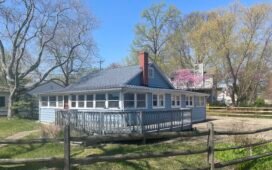
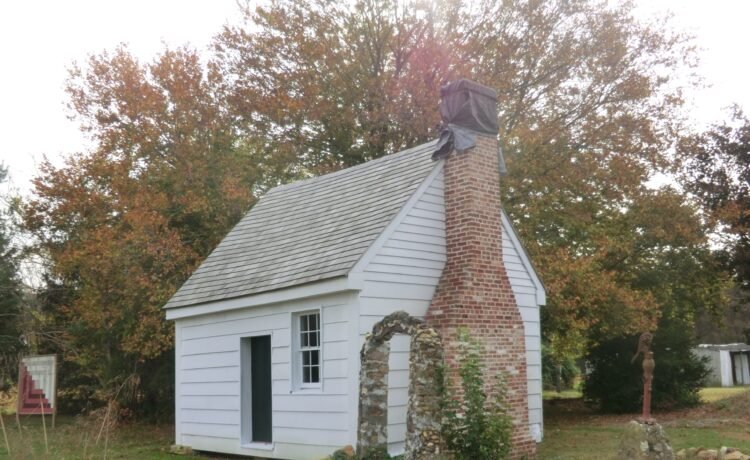
James Webb Cabin (Caroline County) offers a rare glimpse into everyday life for mid-19th-century African American families on Maryland’s Eastern Shore. Built around 1852 by James H. Webb, a free African American farmer, the one-room, hand-hewn log cabin was home to Webb, his wife Mary Ann, their children, and Webb’s father. Mary Ann and the children had previously been enslaved, showing how freedom and enslavement often existed side by side in the region. Constructed from materials gathered nearby, the cabin features an open fireplace, a small loft accessed by a ladder, and a “potato hole” used for storage. The Caroline Historical Society maintains the cabin, offering visitors the chance to learn about the history of enslavement and freedom on a human scale.
The Chesapeake by Water

The Chesapeake Bay Maritime Museum (Talbot County) interprets the history of the Bay as a working landscape shaped by shipbuilding, fishing, trade, and transportation and has increasingly highlighted the experiences of enslaved and free African Americans whose labor sustained the Bay economy before and after Emancipation. One key theme explored through exhibitions and programs is the maritime dimension of the Underground Railroad, like “Sailing to Freedom: Maritime Dimensions of the Underground Railroad.” On the Chesapeake, self-emancipation was not always follow roads or rail lines. Many enslaved people found their freedom by using coastal routes, aboard ships or smaller watercraft. Based upon the book, Sailing to Freedom by Dr. Cheryl LaRoche the exhibition expands the understanding of how freedom was achieved and that the history of enslavement also lived on docks, aboard boats, and along tidal shorelines, not just on plantations.

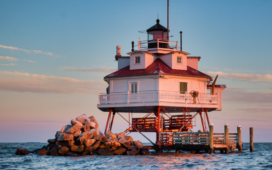
At the northern edge of the Chesapeake, the Havre de Grace Maritime Museum (Harford County) interprets the city’s long relationship with the Susquehanna River and Upper Bay. Embedded within that story is a focused exploration of local Underground Railroad activity and African American freedom seeking. Rather than presenting the Underground Railroad as a single route or organization, the exhibit emphasizes networks of individuals, families, and river communities, highlighting the risks faced by both those escaping and those who helped them. By focusing on local stories, the museum shows that freedom seeking was neither abstract nor distant, but rooted in specific communities and places.
None of these sites tells the full story on its own. Taken together, though, they show how deeply the history of enslavement is embedded in Maryland’s landscapes. These histories are grounded in research uncovered, documented, and shared by institutions and communities. They are tied to roads people still travel, rivers people still work on, and buildings people can still walk into. Visiting these places is one way to better understand how the past continues to shape the state we live in today. Share with us the comments of this post where you have visited that does a great job sharing this important history!
Discover more from Our History, Our Heritage
Subscribe to get the latest posts sent to your email.